Thursday, 15 December 2011


Tuesday, 13 December 2011
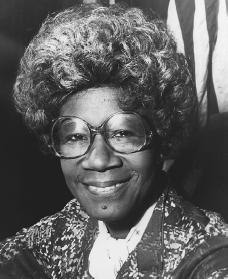
Shirley Chisholm broke ground as the nation's first black congresswoman and the first black presidential candidate
Born: November 30, 1924
Brooklyn, New York
African American congresswoman and politician
stressed the traditional British teachings of reading, writing, and history. Chisholm credits much of her educational successes to this well-rounded early education.
Chisholm attended New York public schools and was able to compete well in the mainly white classrooms. She attended Girls' High School in Bedford-Stuyvesant, a section of Brooklyn. Chisholm won tuition scholarships to several distinguished colleges but was unable to afford the room and board. At the urging of her parents she decided to live at home and attend Brooklyn College.
While training to be a teacher, Chisholm became active in several campus and community groups. She developed an interest in politics and learned the arts of organizing and fund-raising. Soon, she developed a deep resentment toward the role of women in local politics, which, at the time, consisted mostly of staying in the background and playing a secondary role to their male equals. Through campus politics and her work with the National Association for the Advancement of Colored People (NAACP), an organization that was formed in 1909 to work for equal rights for African Americans, Chisholm found a way to voice her opinions about economic and social structures in a rapidly changing nation.
During her successful career as a teacher, Chisholm became involved in several organizations including the League of Women Voters and the Seventeenth Assembly District Democratic Club.
During the time that she served in the assembly Chisholm sponsored fifty bills, but only eight of them passed. One of the successful bills she supported provided assistance for poor students to go on to higher education. Another provided employment insurance coverage for personal and domestic employees. Still another bill reversed a law that caused female teachers in New York to lose their tenure (permanence of position) while they were out on maternity leave.
As a member of Congress, Chisholm attempted to focus her attention on the needs of her constituents (the voters she represented). She served on several House committees including Agriculture, Veterans' Affairs, Rules and Education, and Labor. During the Ninety-first Congress, when she was assigned to the Forestry Committee, she protested her appointment and said that she wanted to work on committees that dealt with issues that were affecting her district. Forestry issues had little or no importance to the people she represented in Bedford-Stuyvesant.
Chisholm was also a strong supporter of women's rights. Early in her career as a congresswoman, she took a stand on the issue of abortion (a woman's right to prevent the birth of a child) and supported a woman's right to choose. She also spoke against traditional roles for women professionals (including secretaries, teachers, and librarians), arguing that women were capable of entering many other professions. Black women especially, she felt, had been pushed into stereotypical roles, or conventional professions, such as maids and nannies. Chisholm supported the idea that they needed to escape, not just by governmental aid, but also by self-effort. Her antiwar and women's liberation views made Chisholm a popular speaker on college campuses.
After her unsuccessful presidential campaign, Chisholm continued to serve in the U.S. House of Representatives for another decade. As a member of the Black Caucus (a group of lawmakers who represent African Americans) she was able to watch black representation in the Congress grow and to welcome other black female congresswomen. In 1982, she announced her retirement from Congress.
Brooklyn, New York
African American congresswoman and politician
Early education and hardship
Shirley Chisholm was born in Brooklyn, New York, to Barbadian parents. When she was three years old, Shirley was sent to live with her grandmother on a farm in Barbados, a former British colony in the West Indies. She received much of her primary education in the Barbadian school system, which Shirley Chisholm.
Reproduced by permission of
Reproduced by permission of
AP/Wide World Photos
. Return to New York
When Chisholm was ten years old, she returned to New York during the height of the Great Depression (1929–39). The Great Depression was a time of severe economic hardship when many people in the United States were unemployed. Life was not easy for the Chisholms in New York, and Shirley's parents sacrificed much for their eight children.Chisholm attended New York public schools and was able to compete well in the mainly white classrooms. She attended Girls' High School in Bedford-Stuyvesant, a section of Brooklyn. Chisholm won tuition scholarships to several distinguished colleges but was unable to afford the room and board. At the urging of her parents she decided to live at home and attend Brooklyn College.
While training to be a teacher, Chisholm became active in several campus and community groups. She developed an interest in politics and learned the arts of organizing and fund-raising. Soon, she developed a deep resentment toward the role of women in local politics, which, at the time, consisted mostly of staying in the background and playing a secondary role to their male equals. Through campus politics and her work with the National Association for the Advancement of Colored People (NAACP), an organization that was formed in 1909 to work for equal rights for African Americans, Chisholm found a way to voice her opinions about economic and social structures in a rapidly changing nation.
From the classroom to politics
After graduating with honors from Brooklyn College in 1946, Chisholm began work as a nursery school teacher and later as a director of schools for early childhood education. She became politically active with the Democratic Party and quickly developed a reputation as a person who challenged the traditional roles of women, African Americans, and the poor. In 1949, she married Conrad Chisholm, and the couple settled in Brooklyn.During her successful career as a teacher, Chisholm became involved in several organizations including the League of Women Voters and the Seventeenth Assembly District Democratic Club.
An outspoken politician
After a successful career as a teacher, Chisholm decided to run for the New York State Assembly. Her ideals were perfect for the times. In the mid-1960s the civil rights movement was in full swing. Across the nation, activists were working for equal civil rights for all Americans, regardless of race. In 1964 Chisholm was elected to the assembly.During the time that she served in the assembly Chisholm sponsored fifty bills, but only eight of them passed. One of the successful bills she supported provided assistance for poor students to go on to higher education. Another provided employment insurance coverage for personal and domestic employees. Still another bill reversed a law that caused female teachers in New York to lose their tenure (permanence of position) while they were out on maternity leave.
A new congresswoman
Chisholm served in the state assembly until 1968, when she decided to run for the U.S. Congress. Her opponent was the civil rights leader James Farmer (1920–). Chisholm won the election and began a long career in the U.S. House of Representatives, lasting from the Ninety-first through the Ninety-seventh Congress (1969–1982).As a member of Congress, Chisholm attempted to focus her attention on the needs of her constituents (the voters she represented). She served on several House committees including Agriculture, Veterans' Affairs, Rules and Education, and Labor. During the Ninety-first Congress, when she was assigned to the Forestry Committee, she protested her appointment and said that she wanted to work on committees that dealt with issues that were affecting her district. Forestry issues had little or no importance to the people she represented in Bedford-Stuyvesant.
Taking a stand
With the Vietnam War (1955–75) raging overseas, Chisholm protested the amount of money being spent for the defense budget while social programs suffered. The Vietnam War was a conflict in which South Vietnam, supported by the United States, was fighting against a takeover by the Communist government of North Vietnam. Chisholm argued that money should not be spent for war while many Americans were hungry, poorly educated, and without adequate housing.Chisholm was also a strong supporter of women's rights. Early in her career as a congresswoman, she took a stand on the issue of abortion (a woman's right to prevent the birth of a child) and supported a woman's right to choose. She also spoke against traditional roles for women professionals (including secretaries, teachers, and librarians), arguing that women were capable of entering many other professions. Black women especially, she felt, had been pushed into stereotypical roles, or conventional professions, such as maids and nannies. Chisholm supported the idea that they needed to escape, not just by governmental aid, but also by self-effort. Her antiwar and women's liberation views made Chisholm a popular speaker on college campuses.
Presidential contender
In 1972 Chisholm ran for the highest office in the land—President of the United States of America. In addition to her interest in civil rights, she spoke out about the judicial system in the United States, police brutality, prison reform, gun control, drug abuse, and numerous other topics. Chisholm did not win the Democratic nomination, but she did win an impressive 10 percent of the votes within the party. As a result of her candidacy, Chisholm was voted one of the ten most admired women in the world.After her unsuccessful presidential campaign, Chisholm continued to serve in the U.S. House of Representatives for another decade. As a member of the Black Caucus (a group of lawmakers who represent African Americans) she was able to watch black representation in the Congress grow and to welcome other black female congresswomen. In 1982, she announced her retirement from Congress.
Monday, 12 December 2011
Tuesday, 6 December 2011
Monday, 5 December 2011
On Why Jazz Isn’t Cool Anymore . . . .by Nicholas Payton
On Why Jazz Isn’t Cool Anymore . . . .
Jazz died in 1959.
There maybe cool individuals who say they play Jazz, but ain’t shit cool about Jazz as a whole.
Jazz died when cool stopped being hip.
Jazz was a limited idea to begin with.
Jazz is a label that was forced upon the musicians.
The musicians should’ve never accepted that idea.
Jazz ain’t shit.
Jazz is incestuous.
Jazz separated itself from American popular music.
Big mistake.
The music never recovered.
Ornette tried to save Jazz from itself by taking the music back to its New Orleanian roots, but his efforts were too esoteric.
Jazz died in 1959, that’s why Ornette tried to “Free Jazz” in 1960.
Jazz is only cool if you don’t actually play it for a living.
Jazz musicians have accepted the idea that it’s OK to be poor.
John Coltrane is a bad cat, but Jazz stopped being cool in 1959.
The very fact that so many people are holding on to this idea of what Jazz is supposed to be is exactly what makes it not cool.
People are holding on to an idea that died long ago.
Jazz, like the Buddha, is dead.
Let it go, people, let it go.
Paul Whiteman was the King of Jazz and someday all kings must fall.
Jazz ain’t cool, it’s cold, like necrophilia.
Stop fucking the dead and embrace the living.
Jazz worries way too much about itself for it to be cool.
Jazz died in 1959.
The number one Jazz record is Miles Davis’ Kind Of Blue.
Dave Brubeck’s Time Out was released in 1959.
1959 was the coolest year in Jazz.
Jazz is haunted by its own hungry ghosts.
Let it die.
You can be martyrs for an idea that died over a half a century if y’all want.
Jazz has proven itself to be limited, and therefore, not cool.
Lot’s wife turned to a pillar of salt from looking back.
Jazz is dead.
Miles ahead.
Some may say that I’m no longer the same dude who recorded the album with Doc Cheatham.
Correct: I’m not the same dude I was 14 years ago.
Isn’t that the point?
Our whole purpose on this planet is to evolve.
The Golden Age of Jazz is gone.
Let it go.
Too many necrophiliacs in Jazz.
You’re making my case for me.
Some people may say we are defined by our limitations.
I don’t believe in limitations, but yes, if you believe you are limited that will define you.
Definitions are retrospective.
And if you find yourself getting mad, it’s probably because you know Jazz is dead.
Why get upset if what I’m saying doesn’t ring true?
I can’t speak for anyone else, but I don’t play Jazz.
I play Postmodern New Orleans music.
Louis Armstrong and Danny Barker play Traditional New Orleans Music.
Ellis Marsalis and James Black play Modern New Orleans music.
Kidd Jordan and Clyde Kerr play Avant-garde New Orleans music.
Donald Harrison plays Neoclassical New Orleans music.
I play Postmodern New Orleans music.
I am a part of a lineage.
I am a part of a blood line.
My ancestors didn’t play Jazz, they played Traditional, Modern and Avant-garde New Orleans Music.
I don’t play Jazz.
I don’t let others define who I am.
I am a Postmodern New Orleans musician.
I create music for the heart and the head, for the beauty and the booty.
The man who lets others define him is a dead man.
With all due respect to the masters, they were victims of a colonialist mentality.
Blacks have been conditioned for centuries to be grateful for whatever crumbs thrown to them.
As a postmodern musician, it’s my duty to do better than my predecessors.
To question, reexamine and redefine what it is that we do.
They accepted it because they had to.
Because my ancestors opened the door for me, I don’t have to accept it.
Louis bowed and scraped so Miles could turn his back.
It’s called evolution.
It’s the colonialist mentality that glorifies being treated like a slave.
There is nothing romantic about poor, scuffling Jazz musicians.
Fuck that idea.
It’s not cool.
Jazz is a lie.
America is a lie.
Playing Jazz is like running on a treadmill: you may break a sweat, but ultimately you ain’t going nowhere.
Some people may say we are limited.
I say, we are as limited as we think.
I am not limited.
Jazz is a marketing ploy that serves an elite few.
The elite make all the money while they tell the true artists it’s cool to be broke.
Occupy Jazz!
I am not speaking of so-called Jazz’s improvisational aspects.
Improvisation by its very nature can never be passé, but mindsets are invariably deadly.
Not knowing is the most you can ever know.
It’s only when you don’t know that “everything” is possible.
Jazz has nothing to do with music or being cool.
It’s a marketing idea.
A glaring example of what’s wrong with Jazz is how people fight over it.
People are too afraid to let go of a name that is killing the spirit of the music.
Life is bigger than music, unless you love and/or play Jazz.
The art, or lack thereof, is just a reflection.
Miles Davis personified cool and he hated Jazz.
What is Jazz anyway?
Life isn’t linear, it’s concentric.
When you’re truly creating you don’t have time to think about what to call it.
Who thinks of what they’ll name the baby while they’re fucking?
Playing Jazz is like using the rear-view mirror to drive your car on the freeway.
If you think Jazz is a style of music, you’ll never begin to understand.
It’s ultimately on the musicians.
People are fickle and follow the pack.
Not enough artists willing to soldier for their shit.
People follow trends and brands.
So do musicians, sadly.
Jazz is a brand.
Jazz ain’t music, it’s marketing, and bad marketing at that.
It has never been, nor will it ever be, music.
Here lies Jazz (1916 – 1959).
Too many musicians and not enough artists.
I believe music to be more of a medium than a brand.
Silence is music, too.
You can’t practice art.
In order for it to be true, one must live it.
Existence is not contingent upon thought.
It’s where you choose to put silence that makes sound music.
Sound and silence equals music.
Sometimes when I’m soloing, I don’t play shit.
I just move blocks of silence around.
The notes are an afterthought.
Silence is what makes music sexy.
Silence is cool.
- Nicholas Payton
Please check out his blog at http://nicholaspayton.wordpress.com/
There maybe cool individuals who say they play Jazz, but ain’t shit cool about Jazz as a whole.
Jazz died when cool stopped being hip.
Jazz was a limited idea to begin with.
Jazz is a label that was forced upon the musicians.
The musicians should’ve never accepted that idea.
Jazz ain’t shit.
Jazz is incestuous.
Jazz separated itself from American popular music.
Big mistake.
The music never recovered.
Ornette tried to save Jazz from itself by taking the music back to its New Orleanian roots, but his efforts were too esoteric.
Jazz died in 1959, that’s why Ornette tried to “Free Jazz” in 1960.
Jazz is only cool if you don’t actually play it for a living.
Jazz musicians have accepted the idea that it’s OK to be poor.
John Coltrane is a bad cat, but Jazz stopped being cool in 1959.
The very fact that so many people are holding on to this idea of what Jazz is supposed to be is exactly what makes it not cool.
People are holding on to an idea that died long ago.
Jazz, like the Buddha, is dead.
Let it go, people, let it go.
Paul Whiteman was the King of Jazz and someday all kings must fall.
Jazz ain’t cool, it’s cold, like necrophilia.
Stop fucking the dead and embrace the living.
Jazz worries way too much about itself for it to be cool.
Jazz died in 1959.
The number one Jazz record is Miles Davis’ Kind Of Blue.
Dave Brubeck’s Time Out was released in 1959.
1959 was the coolest year in Jazz.
Jazz is haunted by its own hungry ghosts.
Let it die.
You can be martyrs for an idea that died over a half a century if y’all want.
Jazz has proven itself to be limited, and therefore, not cool.
Lot’s wife turned to a pillar of salt from looking back.
Jazz is dead.
Miles ahead.
Some may say that I’m no longer the same dude who recorded the album with Doc Cheatham.
Correct: I’m not the same dude I was 14 years ago.
Isn’t that the point?
Our whole purpose on this planet is to evolve.
The Golden Age of Jazz is gone.
Let it go.
Too many necrophiliacs in Jazz.
You’re making my case for me.
Some people may say we are defined by our limitations.
I don’t believe in limitations, but yes, if you believe you are limited that will define you.
Definitions are retrospective.
And if you find yourself getting mad, it’s probably because you know Jazz is dead.
Why get upset if what I’m saying doesn’t ring true?
I can’t speak for anyone else, but I don’t play Jazz.
I play Postmodern New Orleans music.
Louis Armstrong and Danny Barker play Traditional New Orleans Music.
Ellis Marsalis and James Black play Modern New Orleans music.
Kidd Jordan and Clyde Kerr play Avant-garde New Orleans music.
Donald Harrison plays Neoclassical New Orleans music.
I play Postmodern New Orleans music.
I am a part of a lineage.
I am a part of a blood line.
My ancestors didn’t play Jazz, they played Traditional, Modern and Avant-garde New Orleans Music.
I don’t play Jazz.
I don’t let others define who I am.
I am a Postmodern New Orleans musician.
I create music for the heart and the head, for the beauty and the booty.
The man who lets others define him is a dead man.
With all due respect to the masters, they were victims of a colonialist mentality.
Blacks have been conditioned for centuries to be grateful for whatever crumbs thrown to them.
As a postmodern musician, it’s my duty to do better than my predecessors.
To question, reexamine and redefine what it is that we do.
They accepted it because they had to.
Because my ancestors opened the door for me, I don’t have to accept it.
Louis bowed and scraped so Miles could turn his back.
It’s called evolution.
It’s the colonialist mentality that glorifies being treated like a slave.
There is nothing romantic about poor, scuffling Jazz musicians.
Fuck that idea.
It’s not cool.
Jazz is a lie.
America is a lie.
Playing Jazz is like running on a treadmill: you may break a sweat, but ultimately you ain’t going nowhere.
Some people may say we are limited.
I say, we are as limited as we think.
I am not limited.
Jazz is a marketing ploy that serves an elite few.
The elite make all the money while they tell the true artists it’s cool to be broke.
Occupy Jazz!
I am not speaking of so-called Jazz’s improvisational aspects.
Improvisation by its very nature can never be passé, but mindsets are invariably deadly.
Not knowing is the most you can ever know.
It’s only when you don’t know that “everything” is possible.
Jazz has nothing to do with music or being cool.
It’s a marketing idea.
A glaring example of what’s wrong with Jazz is how people fight over it.
People are too afraid to let go of a name that is killing the spirit of the music.
Life is bigger than music, unless you love and/or play Jazz.
The art, or lack thereof, is just a reflection.
Miles Davis personified cool and he hated Jazz.
What is Jazz anyway?
Life isn’t linear, it’s concentric.
When you’re truly creating you don’t have time to think about what to call it.
Who thinks of what they’ll name the baby while they’re fucking?
Playing Jazz is like using the rear-view mirror to drive your car on the freeway.
If you think Jazz is a style of music, you’ll never begin to understand.
It’s ultimately on the musicians.
People are fickle and follow the pack.
Not enough artists willing to soldier for their shit.
People follow trends and brands.
So do musicians, sadly.
Jazz is a brand.
Jazz ain’t music, it’s marketing, and bad marketing at that.
It has never been, nor will it ever be, music.
Here lies Jazz (1916 – 1959).
Too many musicians and not enough artists.
I believe music to be more of a medium than a brand.
Silence is music, too.
You can’t practice art.
In order for it to be true, one must live it.
Existence is not contingent upon thought.
It’s where you choose to put silence that makes sound music.
Sound and silence equals music.
Sometimes when I’m soloing, I don’t play shit.
I just move blocks of silence around.
The notes are an afterthought.
Silence is what makes music sexy.
Silence is cool.
- Nicholas Payton
Please check out his blog at http://nicholaspayton.wordpress.com/
Sunday, 4 December 2011
“Humanity and the Importance of Jazz”
Dr. Martin Luther King, Jr.
Opening speech at the 1964 Berlin Jazz Festival
“Humanity and the Importance of Jazz”
Opening speech at the 1964 Berlin Jazz Festival
“Humanity and the Importance of Jazz”
“Jazz speaks for life. The Blues tell the story of life’s difficulties, and if you think for a moment, you will realize that they take the hardest realities of life and put them into music, only to come out with some new hope or sense of triumph. This is triumphant music.
Modern Jazz has continued in this tradition, singing the songs of a more complicated urban existence. When life itself offers no order and meaning, the musician creates an order and meaning from the sounds of the earth which flow through his instrument.
It is no wonder that so much of the search for identity among American Negroes was championed by Jazz musicians. Long before the modern essayists and scholars wrote of “racial identity” as a problem for a multi-racial world, musicians were returning to their roots to affirm that which was stirring within their souls.
Much of the power of our Freedom Movement in the United States has come from this music. It has strengthened us with its sweet rhythms when courage began to fail. It has calmed us with its rich harmonies when spirits were down.
And now, Jazz is exported to the world. For in the particular struggle of the Negro in America there is something akin to the universal struggle of modern man. Everybody has the Blues. Everybody longs for meaning. Everybody needs to love and be loved. Everybody needs to clap hands and be happy. Everybody longs for faith. In music, especially this broad category called Jazz, there is a stepping stone towards all of these.”
Jazz--a people's music?
Issue 61 of INTERNATIONAL SOCIALISM JOURNAL Published Winter 1993 Copyright © International Socialism
CHARLIE HORE
Introduction
Jazz music has become one of the 20th century's most important and enduring art forms. Yet it survives today in a paradoxical state. On the one hand, the audience for jazz is now larger and more diverse, both socially and geographically, than ever before. Millions of people who don't see themselves as jazz fans regularly listen to live jazz, and most people who regularly buy records or CDs own some jazz. Pubs and bars which feature live music will often have jazz one night, rock the next, and folk the night after; and much the same audience will turn up to hear all three.
On the other hand, jazz as a constantly innovative and evolving artform is in decline, and has been for the last 20 years. Throughout the 1970s and the 1980s, there were no fundamental developments in the music on the scale of bebop or 1960s 'new jazz'. During that period not one new musician emerged who even remotely approached the stature of figures like Louis Armstrong, Duke Ellington, Charlie Parker, Miles Davis or John Coltrane.1 This is in no way intended to denigrate the many fine artists playing today; it is rather to state the simple fact that jazz has lost its position at the leading edge of musical development to other musical forms.
The point of this article is to attempt an explanation of this decline by looking at the ways in which jazz and other forms of black music grew out of the black American experience,2 and how these musical forms have changed as a result of changes in black lives and experiences. Trotsky argued, in Literature and Revolution, that:
... art should, in the first place, be judged by its own law, that is, by the law of art. But Marxism alone can explain why and how a given tendency in art has originated in a given period of history; in other words, who it was made a demand for such an artistic form and not for another, and why... New artistic needs or demands for new literary and artistic points of view are stimulated by economics, through the development of a new class... Artistic creation is always a complicated turning inside out of old forms, under the influence of stimuli which originate outside of art.3
I want to argue that this method can be extended to the formation of black American culture, in the very specific circumstances of slavery and post-emancipation institutionalised racism. In and of America, yet shut out from American society proper, blacks created a culture (in the widest sense of a way of life) which drew both from African cultures and the European ways of life forced on them. As Leroi Jones put it, in his seminal Blues People,
... the ugly fact that the Africans were forced into an alien world where none of the references or cultural shapes of any familiar human attitudes were available is the determinant of the kind of existence they had to eke out here: not only slavery itself but the particular circumstance in which it existed. The African cultures, the retention of some parts of these cultures in America, and the weight of the stepculture produced the American Negro... the development of African music to American Negro music (a new music) represents to me this whole process in microcosm.4
Just as black religions took the forms of Christianity and evolved into something neither European nor African, but rather a black American synthesis of the two, so black music developed as a synthesis of the many musical forms and traditions available. This gave black musical traditions from their earliest days both a dynamism and an ability to absorb new influences, which helps to explain why black American music has been among the most creative and the most influential musical forms of this century.
From this it follows that jazz cannot be understood in isolation from other forms of American black music. The lines drawn between jazz, blues, gospel, rhythm and blues and other forms are largely ones imposed by white critics.5 The only real distinction recognised by musicians and their audiences for much of this century was that between sacred and secular music. Even here the number of artists who have moved between one and the other suggests that this was a highly permeable boundary.6
New Orleans and beyond
The rise of jazz, as a distinct branch of black music, reflected profound changes in black life at the turn of the century. It was an urban music, centred on New Orleans, New York and Kansas City, not the Mississippi Delta or the Alabama cottonfields. It was played by musicians who aimed to make a living from it (unlike the vast majority of blues or gospel singers). And it was a music made for the poor, derided as not respectable by the vast majority of the black middle classes. It arose, in other words, out of a new black working class with money to spend on entertainment who wanted (or were ready to listen to) something different to the music of the countryside they had left behind.
It's in that sense that the term 'a people's music' fitted jazz in its earliest years. It changed and developed as black workers' lives changed, because it was a music rooted in the black working class ghettos, drawing its inspirations from everyday black life.
This is not to argue that it was somehow a 'working class culture', existing outside of and in opposition to capitalist society. The business--sheet music, recording and all but the smallest venues--was entirely run by whites. And the small numbers of middle class blacks contributed disproportionately to the music's development from its earliest days. Nevertheless, as Eric Hobsbawm argued in The Jazz Scene:
... the crucial factor in the development of jazz, as of all American popular music, the factor which more than any other accounts for the unique American phenomenon of a vigorous and resistant folk-music in a rapidly expanding capitalist society, is that it was never swamped by the cultural standards of the upper classes.7
As we will see later, this is a historically specific description which, beyond a certain period, cannot be sustained. But as an analysis of the music in its formative years, it is of great importance. To give just one example: when you listen to the astonishingly explicit (if you understand the slang) sexual and drugs references used by women blues singers in the 1920s and 1930s, it is clear that this was a music never intended for white (or respectable black) ears.8 The white capitalists who dominated the industry from its earliest years saw it solely as a way of making money. Apart from occasionally toning down the most explicit sexual references, they never made the slightest attempt to control its content. It was simply assumed that the musicians knew what would sell and could produce it on demand (not until the 1950s did any record company even pay musicians for rehearsal time).
Many influences went into the making of jazz, including many elements of European classical and folk music, the former brought by middle class blacks denied entry into the world of concert music. But it was rooted above all in the blues. Blues was a loose and flexible folk form that became codified into the 'traditional' 12 bar blues in the early years of this century. More than other black musical forms it kept crucial elements from African music, in particular the 'blue notes'--pitches which lie between the notes of the classical European scale. While other influences have come and gone, blues has been the seminal influence on jazz since its inception.
Contrary to various claims, no one 'invented' jazz. It emerged at around the same time in a number of different places. But from the early years of this century New Orleans was its crucial seed bed, as the largest and fastest growing city in the south with innumerable opportunities for working musicians--bars, brothels and marching bands among others.
The music quickly spread far and wide as the conditions that had produced jazz came into being in other, northern, cities. Hobsbawm estimated that on the eve of the Depression there were some 60,000 jazz bands and almost 200,000 professional musicians.9 Its spread followed the first great black migration from the south, which began around 1916 (as jobs opened up due to the war) and continued without interruption until the Depression.
The newborn recording industry greatly facilitated jazz's expansion. Record sales leapt from 27 million in 1914 to 100 million in 1921,10 and continued to rise throughout the 1920s. Although most of the music which fuelled the 'Jazz Age' was made by whites watering down the music to the point where a white audience would find it palatable, by the mid-1920s the record companies had discovered a substantial black audience. 'Race' labels were founded, advertised only in black papers and sold only in black areas, which sold massive numbers both of blues and jazz records.
And as the music spread, it developed and changed greatly. Listening to Louis Armstrong playing with King Oliver in 1923, and his Hot Fives and Hot Sevens in Chicago in 1927, is almost to listen to two different people. The later music is crisper, faster, more complex and inventive, and clearly represents a challenging of boundaries, a search for different things to do both with the instrument and with other musicians. The distinctive 'New Orleans' style died away quite quickly, although it underwent innumerable revivals, usually by whites reacting against newer developments in jazz.
One of the crucial defining characteristics of jazz is its search for the new. As a music of individual and collective self expression, which stresses each player working out a personal voice and style, it has always striven to deepen its language and move beyond previous boundaries. That development has always been collective, musicians learning with and from each other. A constant tension has thus run through the history of jazz between its function as dance music and its drive to innovate, which has led different schools to go both away from and back to mass audiences.
That drive for self expression and exploration makes jazz pre-eminently a music that voices both emotions and ideas. There's no space here to address the question of how music does this (and I'm far from qualified to attempt a definitive answer), but one point is important. Although early jazz grew up as entertainment, as a music to relax to and escape from the frustrations of everyday life, it necessarily reflected in its tone, language and emotions what it was that its audience wanted to escape from. It became both an expression of alienation and of attempts to overcome it.
Jazz history is conventionally written about as a series of schools--New Orleans, big band, swing, bebop and so on. As a rough template, this does capture the sense of progression in jazz, but it should be noted that this is a very imperfect way of describing jazz's diverse history. All the 'schools' were named by white critics, not the musicians themselves, and they never simply followed a linear progression--as one came into being, the previous one died. Rather, different schools survived side by side. And many of the most important musicians--Art Tatum, Miles Davis and Sonny Rollins, for example--cannot easily be fitted into that framework.
Kansas City to bebop
The Depression of the late 1920s dealt jazz a mortal blow, as unemployment and poverty hit black workers even harder than whites. Dance halls closed down, records stopped selling and promotors stopped booking tours. Black music didn't disappear (sales of Bessie Smith's records kept the giant Columbia Records solvent through the late 1920s)11 but there wasn't enough work for even a small fraction of the musicians who had been playing in jazz's heyday. There were exceptions, and the major one was Kansas City, which was to produce an enormous number of the most influential musicians of the 1930s and 1940s, among them Lester Young, Ben Webster, Count Basie and Charlie Parker.
The reasons for this were very largely economic. Kansas City had long been the dominant business and entertainment centre for a massive area of the south west. As such it had been a major jazz centre, second only to New Orleans, since the First World War. It also had the dubious distinction of being run by one of the most corrupt political machines ever, that of Boss Prendergast, who ran Kansas City as though Prohibition simply didn't exist. One of the side effects of Prohibition was that in many cities the mob effectively ran the town hall; in Kansas City the town hall was the mob. This produced a massive entertainment district full of opportunities for musicians, and one which, as the depression deepened, pulled in musicians from all the surrounding states.12
The Kansas City musicians developed a particular big band style (swing) which emphasised both strongly rhythmical ensemble playing, and a fast and fluent solo expertise. Their crucial technical innovation was that the drummers laid down the underlying beat on the hi-hat, rather than the bass drum as previously, thus making for a looser, suppler and more 'swinging' (that indefinable but essential quality) form of music. 'Cutting sessions' in which musicians tried to outplay and outlast one another, while others looked on and learnt, were regular events in the clubs late at night, and immensely important training sessions. In effect, they worked as a hothouse of musical development and innovation.13
Swing was popularised through eastern tours, in particular by the Count Basie band, from the mid-1930s onwards, and it became the popular music of the day with astonishing rapidity. By 1939 fully 85 percent of all records sold were of swing bands.14 The music's explosive popularity was due above all to the American economy's recovery from the Depression, creating once again a mass audience with the money to pay for popular entertainment, but it was fuelled by two developments which enormously increased the potential audience: radio and the jukebox.
Although radio networks had been expanding since the mid-1920s, it was only after the depression that radios became cheap enough for most workers to buy (in 1926 a mere 5 million homes had radios).15 The jukebox similarly caught on in the same period--by 1937 there were some 150,000 jukeboxes across the USA.16
Although swing had been entirely a black development, it quickly attracted a host of white imitators. Some--Benny Goodman, Woody Herman, and Tommy Dorsey for example--were genuinely excited by what they saw as a new, vibrant music, and their playing demonstrated a real ability to learn from black innovations (though Goodman was the only white band leader who actually employed black musicians). The majority were simply jumping on a bandwagon. Good or bad, it was the white bands who made the real money out of the swing boom. It wasn't the first time that a black music had been popularised by whites (ragtime), or the first time that white imitators had taken over and sanitised jazz. But it was the first time that big money had been involved.
Revulsion against this white takeover was one of the key factors behind the rise of bebop, the most political form of jazz up to this point. The young musicians who pioneered bebop--Charlie Parker, Dizzy Gillespie, Thelonious Monk, Kenny Clarke and Charlie Christian--had ended up in New York after going through various of the big bands. They wanted, as one of them put it, to 'play something that they can't steal.17
Bebop was marked by two crucial technical innovations. One was rhythmic--taking the underlying beat from the hi-hat to the cymbals, allowing them to play in a faster and more rhythmically diverse style than the previous generation. The other was Charlie Parker's discovery of a completely new set of harmonies to play on conventional chord changes. The combination of the two made bebop the most profound revolution in jazz since Armstrong in the 1920s, and arguably a more important one. It also marked a definitive break with all previous jazz schools--practically no one from any of the older schools ever learned to play bebop.
Bebop's ranks were filled by refugees from the big bands, as America's entry into the Second World War tore many of them apart. Many bands lost key players to the armed forces, while blackouts, petrol rationing and the draft similarly closed many of the biggest dance halls. The smaller bebop bands were cheaper to book and to record (particularly as they played original material, whose copyright could be bought cheaply in the studio). The big bands' decline helped to create a niche for bebop to flourish in.
The politics of bebop
Bebop both prefigured and was shaped by radical changes in black lives during the war. The exodus from the south began again, in even bigger numbers, as jobs opened up in the defence industries of the north, the midwest and California, and almost a million blacks were drafted into the armed forces. For the American ruling class, the Second World War was an all-out war, and they had to fully utilise spare black and female labour, both in defence industries and the armed forces. Leroi Jones noted, for instance, that 'while the number of Negroes [in the armed forces] more than doubled, the number of commissioned officers increased almost eight times.18
The contradiction between the rhetoric of a 'war for democracy' and blacks' centrality to the war effort, and the racism they found in the defence plants and the armed forces produced both a burning resentment against racism, and a confidence and determination that it could be fought. The war years saw the massive March on Washington movement, mass black and white union demonstrations against racism in industry, and innumerable confrontations between black soldiers and racists. This pressure from below forced Roosevelt in 1941 to formally ban segregation throughout the armed forces and industry. Though never fully implemented, it was a symbolic victory of immense importance.19
Most importantly of all, as the Chicago and New York race riots of 1943-44 dramatically showed, blacks were willing to fight back. Bebop was powered by, and spoke to, that new spirit of defiance. When Charlie Parker titled one of his most famous recordings Now's The Time, it was taken to mean just that: now's the time to end racism, '...so I have been assured by every black musician with whom I have ever discussed the question', Frank Kofsky asserted (though Parker himself never said as much).20
Both as a music and in the stances taken by the individual musicians, it reflected that new confidence and self assertiveness: more than any previous form, it stressed the individual soloist, his ideas and his feelings. And in going back to the blues as the roots of jazz, it stressed that this was a black music. As Ross Russell put it:
For urban black people of his generation, Charlie [Parker] was a genuine culture hero. The revolutionary nature of his music was explicit. He had rephrased Negro music without altering its essential truth and purity. Implicit in his lifestyle was defiance of the white establishment... every episode in the cumulative legend of the Bird, however ineffectual and childish, was seen as a blow struck against the forces of oppression. In the mid-1940s there was no Martin Luther King Jr., no Malcolm X... In a sense Charlie was a fore-runner of those militant figures of the political arena. He was completely non-political, in fact never in his lifetime so much as cast a ballot... Charlie Parker was the first angry black man in music.21
Leaving aside the hyperbole, and the equation of 'political' with voting, this is a useful summary of the strengths and weaknesses of bebop as revolt. For while it's true that bebop articulated both the anger and the confidence of many urban blacks, for the musicians their opposition was expressed in purely personal ways: not acting by the rules, putting on the squares. (When Charlie Parker met Jean-Paul Sartre in a Paris nightclub in 1949, his opening line was, 'I'm very glad to have met you, Mr. Sartre. I like your playing very much.' Sartre's reply is not recorded.)22
That stance limited bebop's audience. Bebop was very much a musicians' music, one which made no concessions to the audience: those who were hip would dig, the squares would not. And their definition of 'squares' extended beyond most of the white world to include those blacks (including most older jazz musicians) who found bebop too challenging or too difficult. Louis Armstrong, for instance, famously dismissed it as 'Chinese music'.
Material reasons also limited bebop's audience. The American Federation of Musicians imposed a recording ban in 1942, to get musicians paid proper royalties for radio and jukebox plays. The 'strike' (in reality imposed entirely from above) ended in partial victory in 1944, when the last big record labels signed new contracts. Yet despite the ban, the value of record sales leapt from $50 million in 1941 to $109 million in 1945,23 as the companies reissued their backlist to stay afloat. As a result, two key years in bebop's evolution went unheard by the vast majority of blacks.
Yet the recording ban wasn't the primary reason why bebop remained a minority black taste, probably having as large a white audience as black. Far more important were two new strands of black music that arose during the war, aimed specifically at the new black working class: Chicago rhythm and blues, and the 'jump' music of bandleaders such as Cab Calloway, Wyonie Harris and Louis Jordan. (The 'jump' bands had been around since the late 1930s, but achieved their greatest popularity during the 1940s.) Although they were among the most popular jazz based bands ever, they are rarely given the importance they deserve in jazz histories.24
Both forms stressed showmanship and entertainment, and were played explicitly as dance music, which bebop was not. And both were assiduously promoted by the independent black record labels and radio stations which mushroomed in the immediate post-war years. Both were also seminal to the later rise of rock'n'roll, but that's another story.
Neither rhythm and blues nor jump music were ever explicitly political, in the sense of expressing opposition in their lyrics, but their brash and confident styles gave expression to the new moods, attitudes and expectations which had grown among blacks during the war years, and did so in a far more accessible manner than bebop. There was no necessary opposition between the two: many people happily listened both to Charlie Parker and to Muddy Waters, but the point matters because we can't understand developments in jazz without understanding what else was happening in black music at the time. Jazz was a form of black musical expression, but not always the most important or the most popular one.
It has often been argued that jazz never had a mass black audience, blues and rhythm and blues being always far more popular. There is no way of proving or disproving this for the 1920s and 1930s, when live performances and later radio were the main ways in which music was heard, but in any case it misses the point that for much of this period there was no great distinction between the two. The argument also confuses 'mass' and 'majority'--the jazz audience was probably never a majority of urban blacks, but that doesn't mean that it didn't have a substantial audience. From the later 1940s onwards, however, there was a real divergence among musicians: practically none of the Chicago bluesmen had any jazz background, and very few jazz musicians ever played with them. Although that same divergence began to appear among audiences, it remained the case that jazz retained a large black audience, even if smaller than that for rhythm and blues, until the mid-1960s.
Inside jazz, bebop and the various reactions to it had an enormous influence on the two dominant schools of the 1950s--cool and hard bop. Although the 'cool school' is conventionally dated from Miles Davis's Birth of the Cool recordings of 1949 and 1950 (which were only released under that name in 1957), it was overwhelmingly a movement of white musicians, based mainly on the American West Coast, where there was only a very weak black jazz tradition.
As the cool school developed, it became increasingly marked by a rejection of the blues as jazz's major source, looking more and more to European sources and classical influences, in an attempt to gain a respectability for jazz by presenting it as another form of concert music. Politically, it signified an attempt to divorce jazz from its roots in black culture, to produce a music that 'they' could play. This is not to say that it was all bad--at its best, for instance in the work of Stan Getz, it produced some fine music. But as a school it was sterile, leaving no lasting influences on jazz's subsequent development, and by the early 1960s it had effectively died out.25
Hard bop, on the other hand, was to be one of the most influential schools of jazz ever. It began as a reaction primarily against the cool school, but was also powered by a recognition of the dead end that bebop had reached.
Political jazz--from hard hop to the 'new jazz'
Like bebop, hard bop had an explicitly political edge to it. Frank Kofsky argued that:
Viewed strictly as a movement among musicians (which it wasn't), hard bop amounted to a black rebellion against the bleaching tendencies of the cool/West Coast whites. As such, it tended deliberately to lay particular stress on the contemporary forms of urban black music, in the form of blues and gospel.26
Art Blakey, one of the founders of and seminal figures in hard bop, made the same point rather differently,
The black musician... his thing is to swing. Well, the only way the Caucasian musician can swing is at the end of a rope. Swinging is our field and we should stay in it.27
By the early 1950s bebop found itself in a dead end. With its technical innovations unmatched by any developments in musical forms, it had become increasingly repetitive and derivative of the first generation, many of whom were by then dead or past their prime. Hard bop set out to revitalise bebop by taking its technical develoments and marrying them to more popular forms of black music. Hard bop itself was marked by few technical innovations. What made it different was that it drew from all forms of black American music, in particular gospel and rhythm and blues, and laid a great emphasis on original compositions. It was a music not just explicitly black but proud to be black. And it was to have a profound, if largely unacknowledged, influence on the later rise of soul music.
And it was no accident that it arose in the mid-1950s, as the Civil Rights Movement was beginning in the south, and in the north black pride and aspirations were growing, symbolised by the rise of the Black Muslims. By 1960 there were some 100,000 members of the Muslims in the northern cities, the largest black political movement since the heyday of the National Association for the Advancement of Colored People during World War II. Though few musicians joined them many adopted the Muslim faith as a sign of their alienation from American society.
The rising black movement of the late 1950s and early 1960s increasingly politicised musicians of all generations. Duke Ellington, Count Basie, Coleman Hawkins and Art Blakey among many others all declared their support for the southern struggle. But it was the 'new jazz' musicians of the early 1960s who became the most politically conscious and outspoken, as civil rights gave way to black power. They regularly played benefits for the Student Non-violent Co-ordinating Committee, the Congress for Racial Equality and other civil rights organisations, and gave their compositions increasingly political titles. The first major public showcase for the new music, held in 1964, was billed as 'The October Revolution'. And by 1965 Archie Shepp was arguing that jazz:
... is anti-war; it is opposed to Vietnam; it is for Cuba; it is for the liberation of all people. That is the nature of jazz. That's not far fetched. Why is that so? Because jazz is a music itself born out of oppression, born out of the enslavement of my people.28
Yet within this there was a curious paradox. While the musicians became more explicitly political, their music became increasingly estranged from black audiences. The audience for the new jazz was overwhelmingly white. Think, for instance, of the great live John Coltrane recordings--Live in Paris, Live in Stockholm, Live at the Village Vanguard--not the Harlem Apollo. Even the 'October Revolution' concert was held at a club in New York's West 90s, a predominantly white student/bohemian neighbourhood.
Two processes were at work. The first was inside the new music. The 'new jazz' is harder to define than any other jazz school: what united the musicians who made it was primarily a rejection of what had come before. In striving for more self expression, they moved towards greater complexity, replacing the idea of one single rhythm with poly-rhythms, a pulsing beat which shifted in and out of conventional time, and moving away from the European harmonic structures of keys and chords in favour of a modal system of harmonies. This was in large part inspired by a political rejection of European traditions in favour of African and other traditional music.
Many of the new musicians rejected the very term jazz as a white invention, insisting that what they were playing was simply black music. Some even described the blues as 'slave music' which they had to move beyond. This rejection of the old ways was inspired by a profound revulsion against the devaluation and trivialisation of black culture, as well as being a revolt against the disgusting conditions in which even the highest-paid jazz musicians were forced to work.
At its best--for example in the work of Coltrane, Charles Mingus, Archie Shepp and Albert Ayler--the new jazz produced some of the most moving and profound jazz ever. It is a rich, harsh and exciting music, but one which requires serious concentration. Though the musicians developed in a variety of different directions, one common factor united them--theirs was a serious music to be listened to with respect, it was not dance music. While this attitude propelled them towards greater heights of creativity and inspiration, it also necessarily led them further and further away from a mass audience. The drummer Jerome Cooper summed up their approach:
Take B B King. I've worked with him; he's an entertainer, he's supposed to do that. When you go and see him, he has a show. He's an artist, too, but he's a craftsman. He's an artist and entertainer. I don't consider myself an entertainer. I consider myself an artist and I do not entertain.29
The second factor was the rise of soul music, not just a dance music but one which, even in its least political forms (Tamla Motown), expressed a new black confidence and determination, and, as the 1960s wore on, increasingly explicit pride and demands: Aretha Franklin's Respect, The Impressions' Move On Up and People Get Ready and of course James Brown's Say it Loud, I'm Black and I'm Proud.
Soul and 'popular' music
The struggles waged by blacks in the 1950s and 1960s meant that black music had progressed to a point where all the ideas, frustrations and rages that jazz had expressed instrumentally could now be said out loud. Jazz as protest music was a coded music of attitudes: by the middle 1960s it was possible to go beyond that. And although soul and Tamla quickly found a mass white audience, it always had a proportionally larger black audience. Berry Gordy, Motown's founder, estimated that of a million-selling single 30 percent would be sold to blacks.30
The brash confidence and exuberance that the music radiated had an effect irrespective of what the performers--many of whom were very conservative, and concerned simply to build their careers--intended. Martha Reeves, for instance, always denied that Dancing in the Street had anything to do with rioting. But the way she denied it showed all too clearly how soul reflected different attitudes and aspirations.
Because you are black and it's 1967, a cute teen song gets viewed as some statement. People make you out to be what they think you ought to be. Like I said, I never called anyone to riot. I was calling my ten brothers and sisters to the table. All I wanted was a little gravy. For all of us.31
Few of the people who took to the streets in Watts, Harlem or Newark would have disagreed with those last two sentences. It's important to stress that soul and Tamla were equally authentic expressions of black attitudes, because there was a crucial weakness in the dominant left tradition, which led it to completely misunderstand the importance of youth culture in the 1950s and 1960s. The weakness was the rigid distinction made between 'popular' or 'folk' music (a definition that slipped all too easily into crass nationalism) and 'commercial' music, by definition a bad thing. Here, for instance, is Eric Hobsbawm on rock 'n' roll:
It is an awe-inspiring experience to see substantially the same selection of shockers on the automatic gramophones of little Italian towns as in Manchester, and no doubt Wichita, and to reflect that complete freedom of cultural competition would almost certainly put them on those of Moscow and Shanghai.... the habitual rock-and-roll fan, unless mentally rather retarded, tends to be between ten and 15 years of age. Probably the universal appeal of the fashion is due to this infantilism. How long the rhythm and blues vogue will last, is another question.32
Roll over, Mick Jagger, and tell Professor Hobsbawm the news.
Even Val Wilmer, one of the most astute jazz writers, bemoaned the fact that in Ghana in 1970 the vast majority of young people wanted to listen to James Brown rather than jazz or 'authentic' Ghanaian music.33
Neither rock'n' roll nor soul music fitted Hobsbawm's definition of 'vigorous and resistant folk-music... never swamped by the cultural standards of the upper classes'. Yet in the 1950s and 1960s they became the crucial vehicles for expressing mass alienation from and rebellion against the system, despite being produced by some of the biggest capitalist corporations. They, and not jazz, had become 'a people's music'.
The weakness in Hobsbawm's definition was that it was drawn from a period when essentially all music was produced and heard live, usually by small and geographically limited audiences and when, in the case of jazz, there was a near absolute separation between black and white worlds. The development of urban folk cultures, in America as elsewhere, was a product of relatively short, transitional periods, when a new working class was coming into being. From the 1930s onwards the developments of radio, jukeboxes, television and cheap audio equipment--the mass commoditisation of culture--broke that separation down. (In particular, from the early 1950s onwards, radio and the spread of cheap records opened up a massive white audience for black American music.) As Duncan Hallas argued in a rather different context:
... the question of whether socialist consciousness arises 'spontaneously' amongst workers or is imposed by intellectuals from the 'outside' has absolutely no relevance to modern conditions. It is strictly a non-question because it assumes the existence of a more or less autonomous working-class world outlook into which something is injected. Whether the relatively homogenous working class outlook... was ever so autonomous as has often been supposed may be questioned. In any case it is dead, killed by changing social conditions and above all by the mass media... It is rather ridiculous to argue about whether one should bring ideas from 'outside' to workers who own television sets.34
This development is one that has greatly benefitted the working class, by extending cultural horizons and making generally available a far wider range of cultural experiences than before. It follows from this that the idea of a rigid separation between 'the authentic' and 'the commercial' is one that socialists should treat with great suspicion. At worst, it leads to irrelevance in defending as 'real' popular music that almost no one listens to (as the British Communist Party did with the folksong revival in the 1950s, in an attempt to defend 'British' culture against 'creeping Americanisation'). At best it leads to the elitist attitudes which dominate the media studies industries, that all commercially produced mass culture is mindless pap, and that workers, sponge-like, absorb all its reactionary messages when they consume it.35
The reality is that really popular mass culture, precisely because it is selling to a mass audience, has to speak to the lives of that audience. As people's lives and experiences change, so popular culture has to change to reflect that. At high points of struggle (as in the 1960s), it reflects that struggle. And while it's true that many aspects of popular culture are laden with ideology, workers interpret those messages in the light of their own experiences, rather than swallowing them wholesale.
Jazz since the 1960s
From the 'new jazz' onwards, jazz went into a decline as other, more dynamic, forms of black music attracted new generations of black musicians. The 'new jazz' itself, influential as Coltrane continued to be, produced very little in the way of a second generation. This was partly because of its isolation from newer forms of black music, and to a lesser extent because many of its founders moved on to academia. Black studies courses, one of the few tangible gains of the 1960s, provided for many of the musicians the most stable jobs they had ever had, and their growth took away from regular playing many musicians.36
By the late 1960s there was a return among many jazz musicians to a more approachable dance music, taking in influences from soul and rock music. Miles Davis was once again crucial to this shift, with Bitches Brew and Live-Evil being credited as beginning the jazz-rock or jazzfunk style which was to flourish in the 1970s and 1980s with bands such as the Crusaders, and those of Bootsy Collins and Maceo Parker. But it was clear that these were black groups drawing on jazz as one influence among many, rather than jazz groups who were taking the music forwards.
The rise of jazz-funk was seen by some simplistic commentators as the musical parallel to the decline of the black movement in the 1970s and 1980s, an apolitical and commercialised music for apolitical times. In fact, at its best it represented a much more interesting process: the convergence of a number of previously separated threads of black American music. Musicians who had begun their working lives in soul bands were looking for forms that allowed them greater freedom, while jazz musicians were looking for ways back to the mainstream black audience; and both were heavily influenced by musicians like Sly Stone and Jimi Hendrix who had begun to weld together blues, soul and rock music in distinctive new ways.
While individual 'new jazz' musicians continued to develop their art, such as Archie Shepp and Ornette Coleman, much of the vitality of jazz over the last 20 years came from the older musicians--Miles Davis, Sonny Rollins and Art Blakey in particular. Yet the fact remains that they were evolving and honing their past styles, rather than making any new breakthroughs. Recent developments in rap and hip-hop have shown that jazz remains an important influence for black musicians to draw on, but also that it is no longer at the leading edge of black music. It remains a vital part of black music, even if today mostly a subsidiary one, but one which develops primarily by going back to its past.
It was no accident that the most interesting development in jazz over the last few years, the growth of black British jazz, drew its inspiration overwhelmingly from hard bop--both a political and a musical inspiration. Hard bop represented for the musicians both a music of black pride and dance music for a mass audience--the last major jazz school to do both.
Jazz flourished, waxed and waned, and has been declining for a number of years as the music on the edge of progress. It is important not to mourn this, or pretend that it's not happened, but to understand why. For understanding the ways in which jazz was rooted in the growth of the black American working class also helps us to understand the most important development in black music in the 1980s--the explosion of urban African music onto the world stage. From Algerian rai to South African township mbaganga, the new musics coming out of Africa are products of the creation of African working classes, some of them stretching back 20 or 30 years, others of much more recent vintage.
Like jazz, those musics have developed as syntheses of 'traditional' music with Western influences, both from the many strands of black American music and Western pop music generally. And like jazz too, those musics have shown themselves capable of absorbing many other diverse influences--as in the work of Salif Keita and Youssou N'Dour--and making out of them a music with all the drive and creative power of the best jazz. Similar developments in Latin America, China37 and elsewhere are likewise signs of the growth and stirrings of new working classes. 'World music' is the reflection and product of the rise of a world working class.
Notes This article grew out of a talk given at Marxism 92. Particular thanks are due to Teresa O'Donnell and Martin Smith for their help in clarifying my ideas, to Mike Hobart for his thought provoking comments on my arguments, and to everyone who participated in the discussion at the meeting.
- A similar argument is advanced in Nelson George's controversial The Death of Rhythm and Blues (London, 1989) although his book focuses almost entirely on soul and rythm and blues. His basic argument (crudely, that black artists sold their souls to adapt to the tastes of a more lucrative white audience) is questionable, but the book is one of the most interesting critical evaluations of black music in recent years.
- L Jones, Blues People (New York, 1963) pp7-8 (emphases in original). This is the book to read on the social roots of black music, particularly important for his insistence on the diversity of African cultures, a valuable antidote to the essentialist arguments of more recent 'Africanist' writers. For more detailed descriptions of how this black American culture was created, see E Genovese, Roll, Jordan, Roll (New York, 1976) and L Levine, Black Culture and Black Consciousness (New York, 1977).
- F Newton, The Jazz Scene (London, 1963) p43. The book has since been reissued under Hobsbawm's own name (London, 1990). Francis Newton was the pseudonym Hobsbawm used for his writings on jazz. He justified this by arguing that he wanted to keep a separation between his historical work and his jazz writing, but it's probable that the Communist Party's view of jazz as 'decadent' was an equally important reason.
- This point has aroused a great many controversies in discussions, and it's therefore worth saying something about the role of whites in jazz. I am emphatically not arguing the (patronising if not racist) position that 'only blacks can play jazz'--one of the first records that converted me to jazz was a live concert of Joe Turner and Buck Clayton backed by the Zagreb Jazz Quartet! Since the 1940s, when it became possible for multi-racial bands to play together in America, every major figure from Parker to Coltrane included at least one white player in a band at one time or another, so clearly they didn't believe it either. What I will argue is that, as jazz is a product of black experiences in America, whites can only properly play it if they have some appreciation of and respect for those experiences and traditions. And the simple truth is that most white incursions into jazz (Paul Whiteman, swing, cool and the endless Dixieland revivals) have been attempts to appropriate the music away from black culture. Only a minority of white musicians (in America, that is--the situation has always been very different elsewhere) have ever attempted to play within the black tradition (learning from, rather than stealing from) which probably explains why the number of great white jazz musicians can be counted on the fingers of one hand.
Wednesday, 9 November 2011
Introduction to Black studies course

| Black History Studies presents Introduction to Black Studies Course Introduction to the Study of Black History, Politics, Sociology, Psychology, Science, Art and Religion starting February 2012
Now accredited! |
Introduction to Black Studies Course is a 30 week beginner's course that analyses all the major areas of the Black Experience - the History, the Politics, the Psychology, the Science & Technology, the Arts, and finally, the Religion. All of the information is selected to be of relevance and interest to the Black Community. The information itself is designed to inspire, challenge, and to provoke serious thought.
The course is a highly accessible 30 week programme but it is also rigorous and content laden. It assumes no prior knowledge of the subject areas, but the adult student is taken through an avalanche of information. Reading lists and also course materials are provided.
ACCREDITATION (OPTIONAL)
You now have the opportunity to gain a nationally recognised qualification NCFE Level 1 Award in Personal Achievement (QCF) on completion of this course. There are no entry requirements for this Award. Learners will not have to take any exams but will need to complete a Learner's booklet/portfolio and collect appropriate evidence to show that you have met the qualification's learning outcomes. You must attend the full 30 week course to complete the accreditation.
For more information on the accreditation, contact Charmaine Simpson.
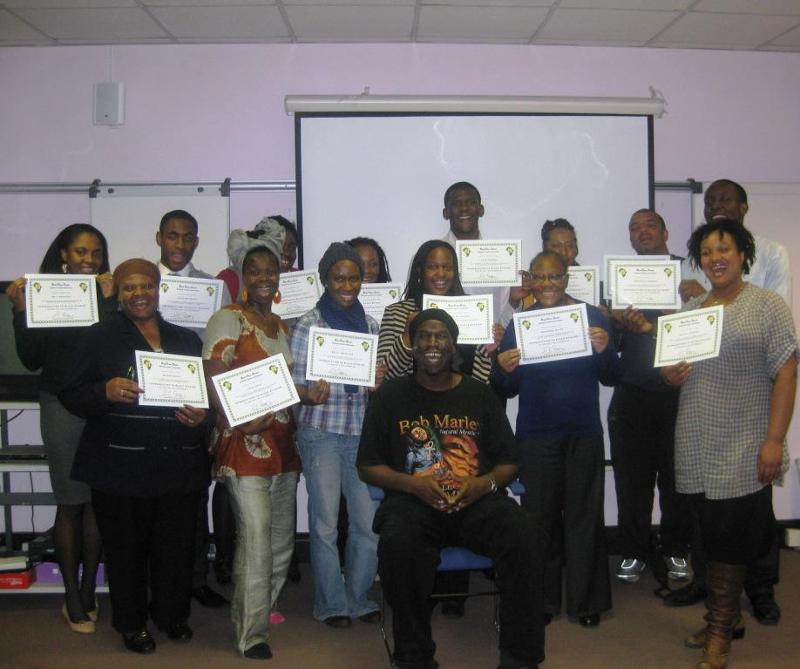
COURSE DATES AND VENUE
North London Course Dates: Thursday 9th February 2012 to Thursday 27th September 2012
South London Course Dates: Tuesday 7th February 2012 to Tuesday 25th September 2012
Course Venue (North London): Parish Room at St Michael's Church, Bounds Green Road, London, N22 8HE. Nearest Train/Tube Station: Wood Green
Course Venue (South London): PCS Learning Centre, 3rd Floor, 231 Vauxhall Bridge Road, London, SW1V 1EH. Nearest Train Station: Victoria. THIS MAY CHANGE TO CLAPHAM JUNCTION DURING 2012
ENROLMENT AND FEES
Non Accredited Course Fees: £95 per term (10 weeks) or £250 for whole 30 week course (saving of £35!)
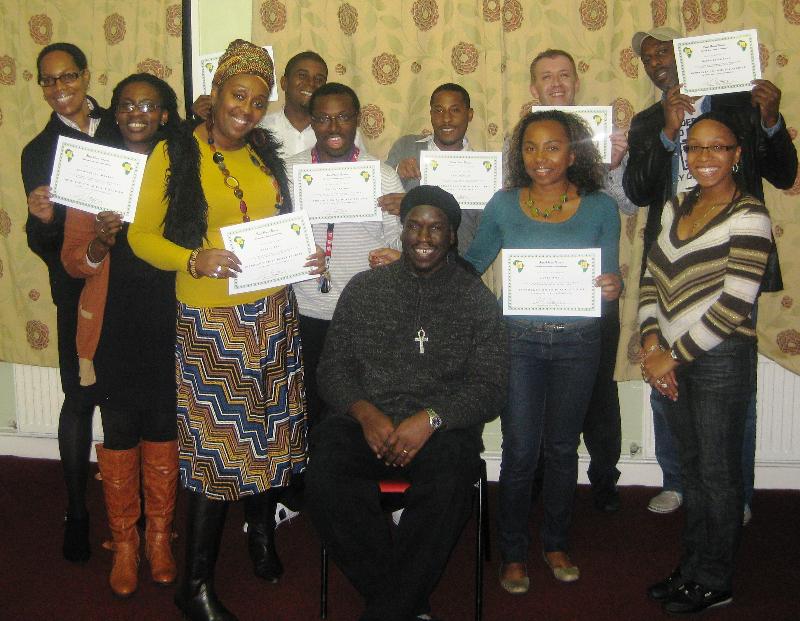
COURSE CONTENT
The course is divided into three terms consisting of the following lectures:
Term 1
INTRODUCTION
Class 1 Introduction to Black Studies
HISTORY
Class 2 The facts concerning the Origins of Humanity
Class 3 Ethnicity of the Ancient Egyptians (Part I)
Class 4 Ethnicity of the Ancient Egyptians (Part II)
Class 5 Origins of Civilisation: Middle East or East Africa?
Class 6 Negro Civilisations on the Asian Continent: Elam, Saba and the Indus Valley
Class 7 The North African Civilisations: Carthage and Numidia
Class 8 The West African Civilisations: Ancient Ghana, Mali and Songhai
Class 9 The East African Civilisations: Kush, Axum and the Swahili
Class 10 Medieval Nubia
Class 3 Ethnicity of the Ancient Egyptians (Part I)
Class 4 Ethnicity of the Ancient Egyptians (Part II)
Class 5 Origins of Civilisation: Middle East or East Africa?
Class 6 Negro Civilisations on the Asian Continent: Elam, Saba and the Indus Valley
Class 7 The North African Civilisations: Carthage and Numidia
Class 8 The West African Civilisations: Ancient Ghana, Mali and Songhai
Class 9 The East African Civilisations: Kush, Axum and the Swahili
Class 10 Medieval Nubia
Term 2
Class 11 Enslavement (Part I)
Class 12 Enslavement (Part II)
Class 12 Enslavement (Part II)
POLITICAL SCIENCE
Classes 13 and 14 Introduction to Black Political Realities
SOCIOLOGY
Class 15 The Birth of Radical Black Sociology
Class 16 Family Organisation in the Black community
Class 17 Black Male/Female Relationships
Class 16 Family Organisation in the Black community
Class 17 Black Male/Female Relationships
PSYCHOLOGY
Class 18 Franz Fanon and the Birth of Black Psychology
Class 19 Developmental Psychology of Black Children
Class 20 Research Findings of Key Black Psychologists
Class 19 Developmental Psychology of Black Children
Class 20 Research Findings of Key Black Psychologists
Term 3
SCIENCE AND TECHNOLOGY
Class 21 The Black World's Contribution to Science and Technology (Part I)
ART & MUSIC
Class 22 The Black World's Contribution to Science and Technology (Part II)
Class 23 Traditions of Ancient African Art: Sahara, Nok, Igbo, Yoruba, and Benin
Class 24 Roots of Black Music
Class 23 Traditions of Ancient African Art: Sahara, Nok, Igbo, Yoruba, and Benin
Class 24 Roots of Black Music
RELIGION
Class 25 Ancient and Traditional Religions of Africa
Class 26 Judaism and the Black World
Class 27 Christianity and the Black World
Class 28 Islam, Buddhism and the Black World
Class 29 Rastafari, Nation of Islam, Kingism and Black Liberation Theology
Class 26 Judaism and the Black World
Class 27 Christianity and the Black World
Class 28 Islam, Buddhism and the Black World
Class 29 Rastafari, Nation of Islam, Kingism and Black Liberation Theology
DISCUSSION
Class 30 Discussion: How can we use Black Studies?
Places on this course are limited and are available on a strictly first come, first served basis and we anticipate that there will be a lot of demand for this course.
If you would like to attend this course, please complete the enrolment online by clicking the button below or contact us at info@blackhistorystudies.com for an enrolment form.

We would appreciate if you could forward this information to all who you believe will be interested.
Regards
Charmaine Simpson
Chief Executive
Black History Studies
Educating the community to educate themselves
Black History Studies Ltd
PO Box 45189
London
N15 3XP
Tel: 0208 881 0660
Fax: 0208 881 0660
Mobile: 07951 234233
Email: info@blackhistorystudies.com
Black History Studies Ltd is a company limited by guarantee (Company No. 6626747), incorporated in England and Wales has its registered office at PO Box 45189, London, N15 3XP.
Subscribe to:
Posts (Atom)