Pages

Friday, 10 October 2014

"Hit the Nigger Baby"

This was a common chant at numerous carnivals, fairs, and circuses across the United States throughout the late 19th century until the mid 1940s, as Americans took part in one of their favorite pastimes, "African Dodger."

The African Dodger, also known as "Hit the Nigger Baby" or "Hit the Coon" was as commonplace in local fairs, carnivals, and circuses as Ferris wheels and roller coasters are today. The purpose of the game was to hit the target with a ball-with one of your three throws-and win a prize. It sounds like a common carnival target game, but there was one unsettling part of the game, namely, the game's target was a real live human being, a "negro" human being. In St. Louis in 1913, it was reported that carnival organizers were "unable for hours today to secure an 'African Dodger' who would allow baseballs to be thrown at his cranium at the usual rate of three for 5 cents;" the reason was that future Hall of Fame fastball pitcher Walter Johnson was rumored to be at the fair ("Don't Want", 1913). The game was so popular nationwide that newspapers mentioned the African Dodger game along with trained animals, illusionists, penny arcades, merry-go-rounds and magic shows in the list of a carnival's attractions. Dodgers made headlines when they were seriously and horrifically injured-otherwise, they were nameless victims.

In 1904 in New York, the Meriden Daily Journal reported how a dodger was smashed in the nose by a professional baseball player. The Journal reported that Albert Johnson dodged "fifty or sixty cents" worth of balls thrown by "Cannon Ball" Gillen of the Clifton Athletic club. Finally Johnson "exposed his head and face a little farther than usual" and was caught by a curve ball that left him unconscious. The article, which was written as a play-by-play commentary on the incident, concluded with the report that it "will probably be necessary to amputate the nose in order to save Johnson's life" ("Hit African", 1904).

But this was not the only report of serious injuries to the dodger. There were numerous reports of such incidents; for example, at the Sheraden Methodist Protestant Church street fair in Pittsburgh, John Jones "failed to dodge" and was hit "squarely in the eye" ("Ball Hits", 1916). In Ohio, Grady Williams was struck in the eye by a stone by someone who "stood to one side and threw a stone at the negro" ("Threw Stone", 1915).

In Connecticut, Walter Smith was hit "with such force that several of the dodger's teeth were knocked out, and the ball was locked so securely within the negro's mouth that it had to be cut to pieces before it could be removed" ("His Mouth", 1908).

In Hanover, PA, William White was assaulted by local baseball players who brought their own heavy balls and "hit the 'coon' nearly every time." The reporter described how "courageously" White took the punishment and wrote that the "negro was pretty well used-up." Only after this, do we find out that the injuries sustained by White were internal and "may prove fatal" (" 'Coon Hitting' ", 1908).

At an Elks Lodge Jubilee in Washington DC, just 17 miles from the White House, the "visiting Elks were royally entertained" as "'nigger babies' were hit with baseballs until they were unable to maintain their upright position..." ("Elks Jubilee", 1908).

There may be no better example of the pervasiveness and brutality of the African Dodger game in American society than an advertisement in the Providence News on September 11, 1924.

    Wants African Dodger to Face Balls at Club Fair

    Do you want to earn a few precious dollars on the evening of September 19 and 20?

    If you do and if you are not at all particular as to what happens to your head why apply at Room 10 in the building at 144 Pine street. Ask for Charlie and tell him you "saw his ad in the paper". Charlie is looking for a lion-hearted and hard-headed young man who will act as an African dodger at the big carnival to be staged by the West Barrington Community Club. The reward? That is a little matter that you can adjust with Charlie. He will treat you fairly and will see that you reach the Rhode Island Hospital safely in the event that that [sic] one of the baseballs comes in contact with your head.

    We beg your pardon for not detailing the duties of an African dodger. He just puts his head through a hole in a big piece of canvass and permits the aforesaid head to be used as a target by young men who toss baseballs.

    One day last week an African dodger was killed in Elizabeth, N.J., and the week before a dodger was killed in Hackensack, but don't permit these deaths to influence you. ("Wants African Dodger", 1924).

The African Dodger game was widespread in American society, in every part of the country. If you could not make it to the fair, you could purchase for $.69 an African Dodger table game, which featured a caricatured black face poking through a canvas reading "Hit the Dodger! Knock Him Out! Every Time You Hit Sambo The Bell Rings" ("Bloomingdales", 1893).
African Dodger Game

But how could this all be? How could such a barbaric practice be such an integral part of a "civilized" society? How could Americans justify this practice? Were there any objections?

One response to objections to the brutality of the African dodger game was to summon authorities to provide "scientific" findings on the topic. A short article in The Wayne County Democrat cited "authorities on anthropology" who "state that the negro has a very heavy and massive cranium constituting a bony arch of great resisting power. One scientist refers to the 'common habit of negroes, of both sexes in butting like rams'[which]...indicates that a negro's head bones have defensive strength unknown in the Caucasian race." The newspaper assures its readers that the dodger doesn't mind. "He seems cheerful about it." The players of the game, the ones who throw the ball, are just men with a "man's desire to display his powers", particularly in front of "women friends." The article finally concludes that until there is evidence that shows "fractured skulls or brain contusions" or until the dodger takes issue himself, the game will continue. A final warning is provided to the dodger who may be considering a new line of work that "He might regret to lose a daily wage that comes with less effort than manual labor" ("The Black Dodger", 1913).

After all, what could be so bad about a game that was an "innocent" sport ("Large Crowd", 19"7) and a game that was "fun for the small boys and the grown-ups as well" ("Dodger", 1907)? A game played by Governors ("Preparing", 1912), famous ball players like Ty Cobb ("Bob Thayer", 1911) and Babe Ruth (Wagenheim, 1974, p. 35), what could be wrong with that?

When legislation was presented in 1915 to ban some forms of the game at Coney Island, the headline read: BAN ON "BONEHEAD" HITS. The proposed ban was framed as "depressing news" for those who may be unable to participate in the "soothing exercise of hitting with a baseball the head of an 'Ethiopian' as it protrudes from a hole in a canvas sheet." But don't just feel sorry for the players, understand that "many persons who have no more profitable use for their heads will join the army of the unemployed" if the bill is passed and Africans are no longer allowed to dodge ("Ban", 1915).
Hit the Nigger Baby

In 1911, some carnivals ushered in a new game for the "progressive era" called the African Dip, the precursor to the dunk tank. The game was "arranged that every time a baseball hits the target a colored man, seated upon a bar, is thrown into a large pool of water. It's said to be lots of fun..." ("It's Called", 1911). This new game didn't entirely replace the African Dodger. Versions of the original African Dodger were still found in the 1950s. Some carnivals and fairs decided to use targets that resembled African Americans instead of using real people. Promoters sold entire family doll racks that were used as targets at Amusement parks (A. J. Smith Mfg. Co., 1914). The development of Amusement parks in permanent locations increased the popularity of the African Dip game because it was hard to travel with the African Dip dunk tank. Riverview Amusement park in Chicago Illinois, was well known for their popular African Dip attraction, which was a staple there until the late 1950s.

It may be hard to imagine a world where such barbaric games were accepted and played, and to understand why people would allow themselves to be targets. This is another example of the complexities of relationships during the Jim Crow era. The idea that African Americans were sub-humans was prevalent and widely accepted. Religious speakers, politicians, and scientists all agreed and "proved" that the African was a "less evolved" creature and therefore not subject to humane treatment. Almost everything in American society pointed to a hierarchical structure, whites on top and blacks at the bottom.

With everyday objects, forms of entertainment, advertising and public policies confirming this hierarchy, it is possible to see how whites came to believe they were superior and how some blacks could internalize these images, practices, attitudes and policies and come to see themselves as inferior and to accept the role of target. It's also difficult for many to see the negative impact of racist games when playing them is associated with fondness of yesteryear. One of the most popular attractions at zoos during this time was the "Negro Village" or "Human Zoo", but that's a topic for another day.

Franklin Hughes
Diversity & Inclusion / Jim Crow Museum
2012

References

Smith Mfg. Co. (1914, March 21). Amusement devices [Advertisement]. The Billboard, p. 76. Retrieved from
http://fultonhistory.com/Newspaper%2015/Billboard/Billboard%201914/Billboard%201914%20-%200873.pdf

Ball hits African Dodger. (1916, July 22). The Gazette Times, p. 1. Retrieved from
http://news.google.com/newspapers?nid=J-ba04ztB30C&dat=19160722&printsec=frontpage&hl=en

Ban on "bonehead" hits. (1915, February 10). The Washington Herald, p. 6. Retrieved from
http://chroniclingamerica.loc.gov/lccn/sn83045433/1915-02-10/ed-1/seq-6/

The black dodger. (1913, September 19). The Wayne County Democrat, p. 3. Retrieved from
http://news.google.com/newspapers?nid=wXCFTzxW9NYC&dat=19130919&printsec=frontpage&hl=en

Bloomingdale's (advertisement). (1893, December 14). The Evening World, p. 8. Retrieved from
http://chroniclingamerica.loc.gov/lccn/sn83030193/1893-12-14/ed-4/seq-8/

Bob Thayer's sporting gossip. (1911, June 2). Washington Times, p. 15. Retrieved from
http://chroniclingamerica.loc.gov/lccn/sn84026749/1911-06-02/ed-1/seq-15/

'Coon Hitting' peril. (1908, September 22). The Philadelphia Record, p. 4. Retrieved from
http://news.google.com/newspapers?nid=QDEWnZBrHwAC&dat=19080922&printsec=frontpage&hl=en

Dodger is an expert but sometimes he is hit. (1907, October 31). Richland Shield and Banner, p. 6. Retrieved from
http://news.google.com/newspapers?nid=cInq4TRmCz8C&dat=19071031&printsec=frontpage&hl=en

Don't want craniums pelted with balls by Walter Johnson. (1913, July 19). Omaha Daily Bee, p. 2. Retrieved from
http://chroniclingamerica.loc.gov/lccn/sn99021999/1913-07-19/ed-1/seq-2/

Elks Jubilee ends. (1908, June 19). The Washington Herald, p. 14. Retrieved from
http://chroniclingamerica.loc.gov/lccn/sn83045433/1908-06-19/ed-1/seq-14/

His mouth full of ball. (1908, August 6). The Philadelphia Record, p. 1. Retrieved from
http://news.google.com/newspapers?nid=QDEWnZBrHwAC&dat=19080806&printsec=frontpage&hl=en

Hit African Dodger. (1904, August 17). The Meriden Daily Journal, p. 6. Retrieved from
http://news.google.com/newspapers?nid=h-OLoDDdPfcC&dat=19040817&printsec=frontpage&hl=en

It's called the "African dip" and it's a new one out at Flemington. (1911, July 28). Trenton True American, p. 1.
Retrieved from
http://news.google.com/newspapers?nid=6g4f2aSzPAQC&dat=19110728&printsec=frontpage&hl=en

Large crowd, ideal weather. (1907, September 19). Custer County Republican, p. 4. Retrieved from
http://chroniclingamerica.loc.gov/lccn/sn94055463/1907-09-19/ed-1/seq-4/

Preparing for the fair. (1912, August 7). Red Bank Register, p. 1. Retrieved from
http://rbr.mtpl.org/data/rbr/1910-1919/1912/1912.08.07.pdf

Stegner, W. (1957). The Big Rock Candy Mountain. New York: Sagamore Press, Inc.

Threw stone at African Dodger; Hit him in eye. (1915, May 15). Youngstown Vindicator, p. 10. Retrieved from
http://news.google.com/newspapers?nid=pqgf-8x9CmQC&dat=19150515&printsec=frontpage&hl=en

Wagenheim, K. (1974). Babe Ruth: His life and legend. New York: Praeger Publishers.

Wants African Dodger to face balls at club fair. (1924, September 11). The Providence News, p. 19. Retrieved from
http://news.google.com/newspapers?nid=Dnd9Dw9jpwAC&dat=19240911&printsec=frontpage&hl=en
This was a common chant at numerous carnivals, fairs, and circuses across the United States throughout the late 19th century until the mid 1940s, as Americans took part in one of their favorite pastimes, "African Dodger."
The African Dodger, also known as "Hit the Nigger Baby" or "Hit the Coon" was as commonplace in local fairs, carnivals, and circuses as Ferris wheels and roller coasters are today. The purpose of the game was to hit the target with a ball-with one of your three throws-and win a prize. It sounds like a common carnival target game, but there was one unsettling part of the game, namely, the game's target was a real live human being, a "negro" human being. In St. Louis in 1913, it was reported that carnival organizers were "unable for hours today to secure an 'African Dodger' who would allow baseballs to be thrown at his cranium at the usual rate of three for 5 cents;" the reason was that future Hall of Fame fastball pitcher Walter Johnson was rumored to be at the fair ("Don't Want", 1913). The game was so popular nationwide that newspapers mentioned the African Dodger game along with trained animals, illusionists, penny arcades, merry-go-rounds and magic shows in the list of a carnival's attractions. Dodgers made headlines when they were seriously and horrifically injured-otherwise, they were nameless victims.
In 1904 in New York, the Meriden Daily Journal reported how a dodger was smashed in the nose by a professional baseball player. The Journal reported that Albert Johnson dodged "fifty or sixty cents" worth of balls thrown by "Cannon Ball" Gillen of the Clifton Athletic club. Finally Johnson "exposed his head and face a little farther than usual" and was caught by a curve ball that left him unconscious. The article, which was written as a play-by-play commentary on the incident, concluded with the report that it "will probably be necessary to amputate the nose in order to save Johnson's life" ("Hit African", 1904).
But this was not the only report of serious injuries to the dodger. There were numerous reports of such incidents; for example, at the Sheraden Methodist Protestant Church street fair in Pittsburgh, John Jones "failed to dodge" and was hit "squarely in the eye" ("Ball Hits", 1916). In Ohio, Grady Williams was struck in the eye by a stone by someone who "stood to one side and threw a stone at the negro" ("Threw Stone", 1915).
In Connecticut, Walter Smith was hit "with such force that several of the dodger's teeth were knocked out, and the ball was locked so securely within the negro's mouth that it had to be cut to pieces before it could be removed" ("His Mouth", 1908).
In Hanover, PA, William White was assaulted by local baseball players who brought their own heavy balls and "hit the 'coon' nearly every time." The reporter described how "courageously" White took the punishment and wrote that the "negro was pretty well used-up." Only after this, do we find out that the injuries sustained by White were internal and "may prove fatal" (" 'Coon Hitting' ", 1908).
At an Elks Lodge Jubilee in Washington DC, just 17 miles from the White House, the "visiting Elks were royally entertained" as "'nigger babies' were hit with baseballs until they were unable to maintain their upright position..." ("Elks Jubilee", 1908).
There may be no better example of the pervasiveness and brutality of the African Dodger game in American society than an advertisement in the Providence News on September 11, 1924.
Wants African Dodger to Face Balls at Club Fair
Do you want to earn a few precious dollars on the evening of September 19 and 20?
If you do and if you are not at all particular as to what happens to your head why apply at Room 10 in the building at 144 Pine street. Ask for Charlie and tell him you "saw his ad in the paper". Charlie is looking for a lion-hearted and hard-headed young man who will act as an African dodger at the big carnival to be staged by the West Barrington Community Club. The reward? That is a little matter that you can adjust with Charlie. He will treat you fairly and will see that you reach the Rhode Island Hospital safely in the event that that [sic] one of the baseballs comes in contact with your head.
We beg your pardon for not detailing the duties of an African dodger. He just puts his head through a hole in a big piece of canvass and permits the aforesaid head to be used as a target by young men who toss baseballs.
One day last week an African dodger was killed in Elizabeth, N.J., and the week before a dodger was killed in Hackensack, but don't permit these deaths to influence you. ("Wants African Dodger", 1924).
The African Dodger game was widespread in American society, in every part of the country. If you could not make it to the fair, you could purchase for $.69 an African Dodger table game, which featured a caricatured black face poking through a canvas reading "Hit the Dodger! Knock Him Out! Every Time You Hit Sambo The Bell Rings" ("Bloomingdales", 1893).
African Dodger Game
But how could this all be? How could such a barbaric practice be such an integral part of a "civilized" society? How could Americans justify this practice? Were there any objections?
One response to objections to the brutality of the African dodger game was to summon authorities to provide "scientific" findings on the topic. A short article in The Wayne County Democrat cited "authorities on anthropology" who "state that the negro has a very heavy and massive cranium constituting a bony arch of great resisting power. One scientist refers to the 'common habit of negroes, of both sexes in butting like rams'[which]...indicates that a negro's head bones have defensive strength unknown in the Caucasian race." The newspaper assures its readers that the dodger doesn't mind. "He seems cheerful about it." The players of the game, the ones who throw the ball, are just men with a "man's desire to display his powers", particularly in front of "women friends." The article finally concludes that until there is evidence that shows "fractured skulls or brain contusions" or until the dodger takes issue himself, the game will continue. A final warning is provided to the dodger who may be considering a new line of work that "He might regret to lose a daily wage that comes with less effort than manual labor" ("The Black Dodger", 1913).
After all, what could be so bad about a game that was an "innocent" sport ("Large Crowd", 19"7) and a game that was "fun for the small boys and the grown-ups as well" ("Dodger", 1907)? A game played by Governors ("Preparing", 1912), famous ball players like Ty Cobb ("Bob Thayer", 1911) and Babe Ruth (Wagenheim, 1974, p. 35), what could be wrong with that?
When legislation was presented in 1915 to ban some forms of the game at Coney Island, the headline read: BAN ON "BONEHEAD" HITS. The proposed ban was framed as "depressing news" for those who may be unable to participate in the "soothing exercise of hitting with a baseball the head of an 'Ethiopian' as it protrudes from a hole in a canvas sheet." But don't just feel sorry for the players, understand that "many persons who have no more profitable use for their heads will join the army of the unemployed" if the bill is passed and Africans are no longer allowed to dodge ("Ban", 1915).
Hit the Nigger Baby
In 1911, some carnivals ushered in a new game for the "progressive era" called the African Dip, the precursor to the dunk tank. The game was "arranged that every time a baseball hits the target a colored man, seated upon a bar, is thrown into a large pool of water. It's said to be lots of fun..." ("It's Called", 1911). This new game didn't entirely replace the African Dodger. Versions of the original African Dodger were still found in the 1950s. Some carnivals and fairs decided to use targets that resembled African Americans instead of using real people. Promoters sold entire family doll racks that were used as targets at Amusement parks (A. J. Smith Mfg. Co., 1914). The development of Amusement parks in permanent locations increased the popularity of the African Dip game because it was hard to travel with the African Dip dunk tank. Riverview Amusement park in Chicago Illinois, was well known for their popular African Dip attraction, which was a staple there until the late 1950s.
It may be hard to imagine a world where such barbaric games were accepted and played, and to understand why people would allow themselves to be targets. This is another example of the complexities of relationships during the Jim Crow era. The idea that African Americans were sub-humans was prevalent and widely accepted. Religious speakers, politicians, and scientists all agreed and "proved" that the African was a "less evolved" creature and therefore not subject to humane treatment. Almost everything in American society pointed to a hierarchical structure, whites on top and blacks at the bottom.
With everyday objects, forms of entertainment, advertising and public policies confirming this hierarchy, it is possible to see how whites came to believe they were superior and how some blacks could internalize these images, practices, attitudes and policies and come to see themselves as inferior and to accept the role of target. It's also difficult for many to see the negative impact of racist games when playing them is associated with fondness of yesteryear. One of the most popular attractions at zoos during this time was the "Negro Village" or "Human Zoo", but that's a topic for another day.
Franklin Hughes
Diversity & Inclusion / Jim Crow Museum
2012
References
Smith Mfg. Co. (1914, March 21). Amusement devices [Advertisement]. The Billboard, p. 76. Retrieved from
http://fultonhistory.com/…/…/Billboard%201914%20-%200873.pdf
Ball hits African Dodger. (1916, July 22). The Gazette Times, p. 1. Retrieved from
http://news.google.com/newspapers…
Ban on "bonehead" hits. (1915, February 10). The Washington Herald, p. 6. Retrieved from
http://chroniclingamerica.loc.gov/…/…/1915-02-10/ed-1/seq-6/
The black dodger. (1913, September 19). The Wayne County Democrat, p. 3. Retrieved from
http://news.google.com/newspapers…
Bloomingdale's (advertisement). (1893, December 14). The Evening World, p. 8. Retrieved from
http://chroniclingamerica.loc.gov/…/…/1893-12-14/ed-4/seq-8/
Bob Thayer's sporting gossip. (1911, June 2). Washington Times, p. 15. Retrieved from
http://chroniclingamerica.loc.gov/…/sn84026749/1911-06-02/e…
'Coon Hitting' peril. (1908, September 22). The Philadelphia Record, p. 4. Retrieved from
http://news.google.com/newspapers…
Dodger is an expert but sometimes he is hit. (1907, October 31). Richland Shield and Banner, p. 6. Retrieved from
http://news.google.com/newspapers…
Don't want craniums pelted with balls by Walter Johnson. (1913, July 19). Omaha Daily Bee, p. 2. Retrieved from
http://chroniclingamerica.loc.gov/…/…/1913-07-19/ed-1/seq-2/
Elks Jubilee ends. (1908, June 19). The Washington Herald, p. 14. Retrieved from
http://chroniclingamerica.loc.gov/…/sn83045433/1908-06-19/e…
His mouth full of ball. (1908, August 6). The Philadelphia Record, p. 1. Retrieved from
http://news.google.com/newspapers…
Hit African Dodger. (1904, August 17). The Meriden Daily Journal, p. 6. Retrieved from
http://news.google.com/newspapers…
It's called the "African dip" and it's a new one out at Flemington. (1911, July 28). Trenton True American, p. 1.
Retrieved from
http://news.google.com/newspapers…
Large crowd, ideal weather. (1907, September 19). Custer County Republican, p. 4. Retrieved from
http://chroniclingamerica.loc.gov/…/…/1907-09-19/ed-1/seq-4/
Preparing for the fair. (1912, August 7). Red Bank Register, p. 1. Retrieved from
http://rbr.mtpl.org/data/rbr/1910-1919/1912/1912.08.07.pdf
Stegner, W. (1957). The Big Rock Candy Mountain. New York: Sagamore Press, Inc.
Threw stone at African Dodger; Hit him in eye. (1915, May 15). Youngstown Vindicator, p. 10. Retrieved from
http://news.google.com/newspapers…
Wagenheim, K. (1974). Babe Ruth: His life and legend. New York: Praeger Publishers.
Wants African Dodger to face balls at club fair. (1924, September 11). The Providence News, p. 19. Retrieved from
http://news.google.com/newspapers…

Wednesday, 8 October 2014

Nicki Minaj & White Supremacy Vs Malcolm X


Minaj desecrates iconic image of Malcolm X
AFRICANGLOBE – Malcolm X and rap music have always fit together like a needle in the groove, connected by struggle, strength and defiance. But three recent episodes involving the use or misuse of Malcolm and other Black icons have raised the question: Has rap lost touch with Black history?
Chart-topping rapstress Nikki Minaj provoked widespread outrage with an Instagram post featuring one of Black history’s most poignant images: Malcolm X peering out the window of his home, rifle in hand, trying to defend his wife and children from firebombs while under surveillance by federal agents. Superimposed on the photo: the title of Sl*utty Minaj’s new song, which denigrates certain Black men and repeats the N-word 42 times.
That came after Minaj’s mentor Lil Wayne recorded a verse last year using the civil rights martyr Emmett Till in a sexual metaphor, and the hip-hop mogul Russell Simmons posted a Harriet Tubman “sex tape” video on his comedy channel.
What is happening to mainstream rap music, which was launched by Simmons and is now ruled by the likes of Minaj and Wayne?
“I don’t want to say today’s rappers are not educated about Black history, but they don’t seem as aware as rap generations before them,” said Jermaine Hall, editor-in-chief of Vibe, the hip-hop magazine and website.
While previous generations had to struggle with the racism and neglect of the 1970s or the government sponsored crack epidemic of the 1980s, Hall said, today’s young people have not faced the same type of racial struggle — “They’re sort of getting further and further away from the civil rights movement.”
“In the ’80s, whether it was KRS-One, Public Enemy, or the Native Tongues, that entire movement, it was very in tune with Black history,” Hall said. “They knew everything about Malcolm, about Martin, about Rosa Parks. Now, the new rappers just aren’t as in tune.”
Indeed, Minaj issued a statement expressing disbelief at the uproar and apologizing to Malcolm’s family “if the meaning of the photo was misconstrued.” Wayne wrote to the Till family to “acknowledge your hurt, as well as the letter you sent to me via your attorneys.” Simmons was the only one to say, “I am sincerely sorry.”
The apologies did not change much for Pierre Bennu, a filmmaker and artist who said Malcolm X’s life was dedicated to advocating for the humanity of Black people, while Minaj’s song was simply dehumanizing.
When he saw Minaj’s manipulation, Bennu said, “I felt punched in the gut.”
The episode inspired him to post a mash-up video (http://bit.ly/1fpoFYB) laying Minaj’s song over the infamous 1941 Walter Lantz cartoon “Scrub Me Mama With A Boogie Beat,” which depicts a town of lazy Black people hypnotized by a seductive washerwoman.
Various mainstream rap artists seem reluctant to defend Minaj and Wayne.
Jasiri X, a rapper whose music focuses on Black empowerment and current events, said many of today’s mainstream rappers use images of revolutionary Black icons to promote an anti-establishment image.
“All the while, they’re being funded and pushed by major corporations,” he said.
“I see Nikki and other artists, whether Kanye or Jay-Z, adopting these revolutionary images or using a clip or saying their name, but never practice the principles which these revolutionaries gave their lives for,” Jasiri said.
It was not always so.
Hip-hop began in the early 1970s as an alternative to gang activity. Before the music was recorded, founding fathers like DJ Afrika Bambaataa — whose slogan was “peace, love, unity and having fun” — would play Malcolm X’s voice over instrumental break beats.
“Not only did it sound funky but it helped raise our consciousness,” Davey wrote on his website.
Davey attended many early rap concerts at Harlem’s Audubon Ballroom, where Malcolm was assassinated. As the music gained steam, X was constantly honored on wax. KRS-One duplicated Malcolm’s gun-in-the-window pose on the cover of his 1988 classic album, “By Any Means Necessary.” In 1991, Tupac rhymed on “Words of Wisdom”: “No Malcolm X in my history text, why is that? / Cause he tried to educate and liberate all Blacks.”
Malcolm’s voice and image appeared on so many records and videos, “many would remark that he was an emcee,” Davey wrote.
Tubman also is a longtime rap staple, mentioned by everyone from Ice Cube (“She helped me run like Harriet Tubman”) to Pharoahe Monch (“A railroad to underground like Harriet Tubman”). Till, too, has been mentioned in songs such as Kanye’s breakthrough 2003 single “Through The Wire.”
But today’s rappers reflect our money-obsessed society, said Bakari Kitwana, whose Rap Sessions organization just moderated a series of community dialogues between the civil rights and hip-hop generations.
“We see a lot of things going on with our young people, and we don’t feel like we are teaching them values that can compete with the way the value of money is ingrained in our culture,” Kitwana said. “Everything is just focused on money. If you can get money, whatever else you’re doing doesn’t matter.”
“It’s reached a crisis point,” he said. “I came up in the ’70s and ’80s, and greed has always been present, but I don’t think I’ve ever seen it like it is now.”
He was echoed by Paradise Gray, who performed in the 1980s with the Afrocentric rap group X Clan.
“Mainstream rap music has lost its reverence for anything besides money,” Gray said.
Today’s rappers threaten to kill people who disrespect them, “but they sit back and let you disrespect our legacy, our culture, our history,” he said.
“What,” Gray asked, “will the disrespect of your humanity and your blackness cost you?”

Saturday, 4 October 2014

African resistance and rebellion: The other side of World War I by Jacques Enaudeau @WWIAfrica

Selective memory of Africans€™’ role in the Great War shows the language of commemoration is rooted in colonial history.
On Sept. 15, 1914, barely six weeks after war broke out in Europe and was quickly exported to the eastern and western shores of Africa, something unexpected happened as it reached the southern tip of the continent. While troops from the South African dominion of the British Empire prepared to invade neighboring German South West Africa (now Namibia), Christiaan Frederick Beyers, the highest-ranking member and commandant of South Africa’s army, resigned.
“It is said that the war is being waged against the ‘barbarism’ of the Germans,” Beyers reportedly wrote to explain his decision. “We have forgiven but not forgotten all the barbarities committed in our own country during the South African War.” He was referring to the Second Anglo-Boer War, a brutal annexation campaign that the British launched and won against Afrikaners 12 years earlier.
His resignation marked the beginning of the Maritz rebellion, named after the general who allied with the Germans to boost its chances of success. Over the next five months, Beyers and a number of other military officers gathered 12,000 Afrikaner troops, proclaimed an independent South African republic and battled an army of 32,000 men — among them 20,000 Afrikaners loyal to the British crown — in hopes of toppling the acting South African government.
Though unsuccessful, the Maritz rebellion is a revealing episode of World War I in Africa. Far from an isolated incident, it is a symbol of the two wars that European empires fought in Africa during the first worldwide conflict in history. As the world reflects on the legacy of Europe’s Great War over the next four years of centenary commemorations, we should question why only one side of Africa’s involvement is publicly acknowledged.
Across the Mediterranean, European powers fought one another to defend their prized possessions and grab new ones when opportunities arose. But there was another, lesser-known side of the war, with colonial powers — with their extraordinary demands in men, money and resources — in opposition to the African populations that resisted colonial rule. The better-known side is an episode of European military history fought across imperial boundaries; the other represents important moments of African sociopolitical histories played out within the limits of future national borders. Only the first registers in public discourse, if briefly, whereas the second remains forgotten.
European powers often claimed the African soldiers fighting for them were nothing but loyal and aspired to serve in their respective armies. Yet colonial administrators spent much of the war coping with local resistance and rebellion, particularly in French West Africa. From individuals feigning illnesses to entire villages fleeing, Africans routinely evaded conscription, something to which only France resorted. Where the French were considered especially vulnerable, locals seized the opportunity to revolt, in northern Dahomey (now Benin), north of Bamako (now in Mali) and in the southern desert of French Sudan (now in Niger).
The language of remembrance should not abide by the rules of commemoration, lest we forget what Africans made happen for themselves during World War I.
While West African troops fought on the western front under French colors, France nonetheless faced the most serious challenge to its colonial rule in West Africa. From November 1915 to September 1916, a large alliance of fortified villages between the Volta and Bani rivers (now in Burkina Faso) assembled to drive the French out. With an armed coalition of 20,000 men at its peak, the revolt became an all-out anti-colonial war. Only after committing overwhelming military resources, bombarding and sacking entire villages did France manage to stop the revolt, with great loss of lives on both sides.
In the words of historian Gregory Mann, the war of Volta-Bani altered the very fabric of relations between the colonial administration and local populations, forcing France to adopt a “language of mutual obligation.” Though different in context and numbers, the Chilembwe uprising in Nyasaland (now Malawi) in January 1915 had a lasting impact as well, so much so that the pastor who led the charge against the British has over the years become a national hero, whose face can be seen on today’s 500 kwacha banknote.
On the face of colonial maps, the scramble for Africa may have been over in 1914. Except for Liberia and Abyssinia (now Ethiopia), the European powers had divided up the continent among themselves 30 years earlier, with only minor changes since. On the ground, however, the colonial invasion continued through World War I, lowering the veil of its benevolence and revealing its exploitative face.
Why, then, does the resistance of Africans to Europe’s Great War remain so absent from the collective consciousness of African and non-African citizens alike?
The African side of World War I does have its historians. Since African nations gained independence, they have flipped the mirror, investigating the blind spots of colonial archives and piecing together the significance and legacy of the white man’s war on the continent. Yet the color of memory remains essentially white, despite the global turn in historical studies of World War I.
The vocabulary commemorating the role of Africans is deeply rooted in the colonial past, which tied Africa and Europe together. Terms such as “allegiance,” “bravery” and “service rendered” reflect a Eurocentric perspective and need to be assessed in the context of their production. Left unchallenged, they otherwise turn history into myth and help maintain a patronizing colonial narrative. The language of remembrance should not abide by the rules of commemoration, lest we forget what Africans made happen for themselves during World War I.
Jacques Enaudeau is a French geographer and freelance cartographer. He is a founder of the World War I in Africa Project with Tanzanian cultural activist Kathleen Bomani. Find out more about their initiative on the project’s website.
The views expressed in this article are the author's own and do not necessarily reflect Al Jazeera America's editorial policy.

Blue Black - like Krishna


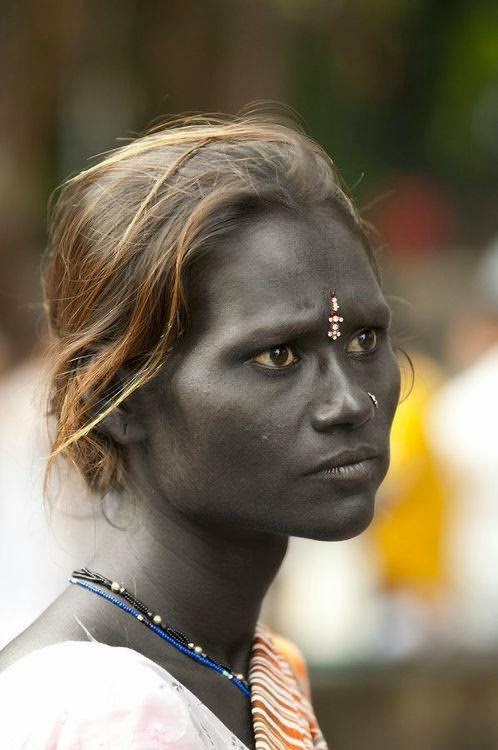
Blue Black - like Krishna. The blackest blue in India and she is subject to extensive prejudice cause of her dark hue! Dravidian ..The ancient "blue race" of India still exists in the bloodlines. Dravidian indeed. Kushite
Indian Beggar in Mumbai, South India

In Irish-Scottish Gaeilge (or Gaelic), people of African descent were historically referred to as the fir gorum, or blue men. People of this race were described as "blue" rather than as "black."

AVATAR-The Blue Black People.
In a 2007 interview with Time magazine, Cameron was asked about the meaning of the term Avatar, to which he replied, "It's an incarnation of one of the Hindu gods taking a flesh form. In this film what that means is that the human technology in the future is capable of injecting a human's intelligence into a remotely located body, a biological body."
Jake's avatar and Neytiri. One of the inspirations for the look of the Na'vi came from a dream that Cameron's mother had told him about.
The look of the Na'vi – the humanoids indigenous to Pandora – was inspired by a dream that Cameron's mother had, long before he started work on Avatar. In her dream, she saw a blue-skinned woman 12 feet (4 m) tall, which he thought was "kind of a cool image". Also he said, "I just like blue. It's a good color … plus, there's a connection to the Hindu deities, which I like conceptually.

Brett Bailey, The Barbican and Black Britons Yvette Gresle | October 2nd, 2014


The South African artist Brett Bailey’s installation, “Exhibit B”, was supposed to open on Tuesday, September 23, at The Vaults, a multi-disciplinary space located in underground sections of London’s Waterloo station. The Barbican had hired out the space for Exhibit B. As guests arrived for the opening of Bailey’s show, which featured black actors chained and in cages, however, they were met by 200 protesters who had blockaded the entrance. The Barbican condemned objectors for preventing artists’ and performers’ “freedom of expression”, but eventually decided that the installation, which was slated to have a five-day run, should be shut down.
Exhibit B is described in PR material as critiquing “… the ‘human zoos’ and ethnographic displays that showed Africans as objects of scientific curiosity through the 19th and early 20th centuries.” Each of the twelve tableaux in the exhibit “features motionless performers placed in settings drawn from real life. Collectively they confront colonial atrocities committed in Africa, European notions of racial supremacy and the plight of immigrants today.  As spectators walk past the exhibits one-by-one, to the sound of lamentations sung live by a Namibian choir, a human gaze is unexpectedly returned.” If Exhibit B was the heartfelt, well-thought out critique of slavery and colonial exploitation that Bailey and the Barbican claimed it to be, why the furore? Why did people object to seeing “tableaux” of silent, entrapped human beings — albeit with the power to gaze back at visitors, inciting guilt, if not recognition of complicity, long-term repercussions on present day circumstances of the descendants of those formerly enslaved peoples, and the ways in which power and privilege continue to be built on these historical practices?
Culture South Africa
On the most obvious level, the exhibit has been criticized for its cavalier treatment of slavery and racial violence. The protests were well-organised, and supported by people across Britain; as The Guardian reported,
The campaign against the exhibition was led by Birmingham-based activist and journalist Sara Myers but drew support from around the country, including noted figures such as Lord Boateng, Britain’s first black cabinet minister.
We won’t revisit those efforts here. The best of the critiques about Bailey’s “provocative” work are here (by Kehinde Andrews), here (TO Molefe) and here (Esther Stanford-Xosei). And London was also not the first time that Exhibit B faced protests or public criticism by antiracist campaigners; at Playfair Library Hall, University of Edinburgh, it also faced serious criticism.
Maybe Brett Bailey’s lack of self-reflection is to be expected; after all, one of his former collaborators told The Guardian that he was well suited to mount the exhibition because as a white South African, he was sufficiently removed from colonialism. Then there was the bizarre revelation (in TO Molefe’s piece in City Press-linked above) that the South African government funded the work. But one of the most significant results of the Exhibit B debacle was that it galvanized people of color or of African descent in Britain; they organized themselves, and rallied to protest their lack of representations in the arts.All that ability to not only “return the gaze” but to also demand and expect change meant that the Barbican was caught with its pants down. Liberals, of course, love to give a ragged handout and claim that downtrodden recipients should be grateful. Tell them what’s what, and one becomes an “extremist.” Note how The Barbican framed the nature of the protests in its press release
… it became impossible for us to continue with the show because of the extreme nature of the protest and the serious threat to the safety of performers, audiences and staff.
They also cried over the fact that its power and privilege was checked:
We find it profoundly troubling that such methods have been used to silence artists and performers and that audiences have been denied the opportunity to see this important work.
Exhibit_B_3002028b
So, who are the ‘extreme’ protestors imagined by the Barbican and who is silencing who?
It so happens that I know most of the protestors, many who are fluent on matters of race in Britain, and alert to their right, as citizens of the United Kingdom, to organised, and peaceful protest. The leaders of this protest are highly respected members of the communities they represent. I have personally heard these leaders, including Sara Myers (the initiator and leader of the ‘Boycott the Human Zoo’ campaign on Change.org), Lee Jasper and Zita Holbourne amongst them, speak on matters of race and the history of organised Black political protest in Britain. They are a diverse group of activists, role models, cultural figures, and intellectuals. Not quite the mob Barbican dreamed up in their Public Relations statements.
On the day of the official hand-over of the petition started by Myers, no one in a position of authority at the Barbican deigned to make themselves available to receive the petition handed to them (despite committing to do so), which was represented by 22,989 signatures of white and black British people and, most importantly, South African citizens.
exhibit b
The Barbican’s refusal to engage with protestors is itself a form of censure. It is one of the many forms that racial violence can take.
Arts producer Julia Farrington, writing about Exhibit B for indexoncensorship.org, makes it very clear that art institutions and funding bodies in the United Kingdom are certainly not thinking about Black artists, curators and audiences when deciding to run shows like Exhibit B. Farrington cites independent arts consultant Jenny Williams:
The black and minority ethnic community contribute around £62m per year into the overall arts budget. Yet, the current yearly figure currently invested in black and minority ethnic-led work is £4.8m.
Given this information, who exactly were the Barbican’s imagined audiences? Bailey (who has been given space to argue his case, including in The Guardian), contradicts himself about this: he has told us the work is ‘for the diversion of (mainly) white audiences.’ Speaking through the Barbican he has also told us: ‘Exhibit B is not a piece about black histories made for white audiences.’
And as Myers points out in her petition,
Bailey himself sounds unsure as to the impact of this work. In an interview with the Guardian he says: “For all I know, I could look back at Exhibit B in 10 years and say, ‘Oh my God, I am doing exactly what they are accusing me of.”
Bailey and The Barbican have demonstrated that they don’t care what the majority of black publics (especially in the UK) think. Neither Bailey nor the Barbican appear to have taken black audiences into account. Perhaps, for them, race is an abstraction, a commodity, a way to draw audiences, or just the right ingredient that creates controversy and notoriety – without, of course, affecting revenues for the institution, or causing aversion to (or worse, a bored dismissal of) the artist’s ill-conceived work.
Bailey assumed the right to represent and speak on behalf of Black Britons’ ancestors – be they of African, Caribbean, or South Asian descent, without consulting those for whom these histories remain a traumatic legacy. Part of Bailey and the Barbican’s public relations campaign is their insistent presentation of so-called objective evidence. They would have us believe that they cannot possibly be racist, and they are teaching us all about suppressed histories. After all, Bailey is fond of reeling out the responses of his black performers: performer after performer is brought out to say that they’re fine with what they are doing, that they understand what they are doing, etc. Of course, none of these exercises include references to the position of relative powerlessness in which an employee (the performer) is placed, having to speak in defence of their powerful employer (Bailey), from whom they are receiving payment, exposure, references for a next gig, etc. In any case, none of these defensive tactics carry any critical weight – not when those in the audience overwhelmingly decide that the patronising exercise of guilt-trauma-drama in front of them isn’t good enough. Full stop.
cdn.mg.co

Friday, 3 October 2014

Herero and Namaqua Genocide


Herero and Namaqua Genocide was a campaign of racial extermination and collective punishment that the government of German South-West Africa (modern-day Namibia) undertook against the Herero and Nama people. It is considered to have been the first genocide of the 20th century. It took place between 1904 and 1907 during the Herero Wars.
On 12 January 1904, the Herero people, led by Samuel Maharero, rebelled against German colonial rule. In August, German general Lothar von Trotha defeated the Herero in the Battle of Waterberg and drove them into the desert of Omaheke, where most of them died of thirst. In October, the Nama people also rebelled against the Germans only to suffer a similar fate.
In total, 24,000–100,000 Herero and 10,000 Nama died. The genocide was characterised by widespread death from starvation and thirst because the Herero who fled the violence were prevented from leaving the Namib Desert. Some sources also claim that the German colonial army systematically poisoned desert wells.
In 1985, the United Nations' Whitaker Report classified the aftermath as an attempt to exterminate the Herero and Nama peoples of South-West Africa, and therefore one of the earliest attempts at genocide in the 20th century. In 2004 the German government recognised and apologised for the events, but has ruled out financial compensation for the victims' descendants..

Exploring the Hidden Racist Past of the Looney Toons by Matt Crowley | September 16th, 2014

rabbitstew
I have an uncomfortable confession to make: I have never liked the Looney Tunes. Despite the cultural pervasiveness of these characters, and a lifelong love of animation on my part, they’ve always struck me as annoying, repetitive, and boring — for all the pandemonium that Bugs Bunny and his ilk ostensibly represent, their chaos is bland, their destruction is predictable, and their lineage is corporate.
To be fair, my exposure to Looney Tunes at the time bore that out pretty well: I grew up in the age of Space Jam and the slew of jerseys, sneakers, McDonald’s toys, pogs, and cookie jars that film spawned. Today is no better, with the Roadrunner and Foghorn Leghorn perhaps most recognizable as shills for companies like Time Warner and GEICO.
Yet this was not always the case, as demonstrated by the excellent Chuck Jones exhibit at the Museum of the Moving Image in Queens. Entitled “What’s Up Doc? The Animation Art of Chuck Jones”, this retrospective illuminates the originality and charm of Jones in particular and the Looney Tunes in general. I learned that Bugs Bunny’s smart-alecky attitude and cigar-like carrot were based on Groucho Marx, and Wile E Coyote’s design was inspired by Mark Twain’s description of the coyote as “a long, slim, sick and sorry-looking skeleton…with a despairing expression of forsakenness and misery, a furtive and evil eye, and a long, sharp face…The coyote is a living, breathing allegory of Want.”
I was also surprised to discover how topical these cartoons were — as a kid watching cartoons on Saturday mornings, I didn’t catch many of the forty-year-old references. Yet Looney Tunes was a definite forerunner to the adult animation of today, poking fun at contemporary politics and pop culture. These cartoons were far from the squeaky-clean version of today: they were vibrant, innovative, and often subversive. While this certainly makes these shorts more interesting, it also means that some of the uglier elements of the time are on full display.
Such elements are abundantly clear in the Censored Eleven, shorts from the Warner Bros catalogue that were withheld from syndication due to racially offensive content. These cartoons have not been broadcast since 1968, though they are available online. I present them below, not to glamorize them but to shed some light on an occasionally fascinating — and often appalling — corner of an American institution.

Hittin’ the Trail for Hallelujah Land

The oldest cartoon of the eleven, Hittin’ The Trail For Hallelujah Land is notable for its plagiarism as well as its offensive subject matter. Released in 1931 — the second Merrie Melodies short ever made — it bears a striking resemblance to Disney’s 1928 release Steamboat Willy, including a Mickey Mouse-like character named Piggy who drives a steamboat.
The film was censored due to the character of Uncle Tom, a doglike creature who runs afoul of some dancing skeletons (who are also markedly similar to an earlier Disney creation entitled The Skeleton Dance). The animal cast of this short makes racist portrayals less apparent, and the stereotype that Uncle Tom falls into — that of the superstitious black man — is so outmoded that I didn’t even initially recognize its bigotry. Beyond this, a lack of focus and some half-baked gags are likely to make this cartoon more of a curiosity than a joy for modern viewers.

Sunday Go to Meetin’ Time & Clean Pastures

1936’s Sunday Go To Meetin’ Time and 1937’s Clean Pastures share religious themes as well as large opening set pieces that provide an opportunity to introduce a cavalcade of racial caricatures — country folk in the former and city dwellers in the latter. Sunday Go To Meetin’ Time is a standard morality tale, about an errant man (Nicodemus) who sneaks out of church to go steal some chickens. When he’s hit on the head and has a dream about the Hell that awaits him, he awakens repentant.

Clean Pastures is, on the whole, a more entertaining and more complex offering. A parody of the film Green Pastures, this short follows the angel Gabriel — a caricature of contemporary performer Stepin Fetchit — as he tries to get Harlemites to come to Heaven (or “Pair-o-Dice” as it’s called here). He is unsuccessful until four angels — caricatures of jazz musicians — suggest using “rhythm” to get people to paradise. The music is a huge success, and droves of folks come to Heaven — including the Devil himself. Offensive stereotyping abounds, but Clean Pastures has at least provided significant critical fodder. Sunday Go To Meetin’ Time, not so much.

Jungle Jitters & The Isle of Pingo Pongo

A pair of riffs on the idea of island savages, Jungle Jitters and The Isle of Pingo Pongo (both released in 1938) share a few of the same barbarian-based gags as well as a surrealist bent. The Isle of Pingo Pongo is set up as a parody of travelogues, while Jungle Jitters is more of a fish-out-of-water scenario, following a traveling salesman who gets kidnapped by natives.
While both feature some cringe-worthy jokes (connecting savage island music with contemporary jazz, a sign reading “Eat at the Dark Brown Derby,” etc.) Jungle Jitters is stronger in terms of narrative and sheer insanity. The climax, which features the islanders’ leader, a Caucasian bird-woman, falling in love with the doglike salesman, showcases a refreshing anything-goes lunacy that’s a Looney Tunes hallmark.

Uncle Tom’s Bungalow

1937’s Uncle Tom’s Bungalow is something of a missed opportunity. Based on the famous abolitionist novel Uncle Tom’s Cabin, this short generally holds true to the themes of its source material — the slaver Legree is the clear antagonist, and the little white girl Eva and little black girl Topsy are presented as friends and essentially equals (making this the least racially segregated of the Censored Eleven). Unfortunately, the slapdash nature of this cartoon undercuts any potential message — the humor is lacking, it relies on an overuse of jokey narration, and the final punch line is a racist gambling joke.

Angel Puss

The only one of the eleven directed by Chuck Jones, Angel Puss (1944) is at once one of the most blithe and most offensive of the banned cartoons. Its storyline of a cat outsmarting an African-American man who is trying to drown him places it in line with the standard aggressor/defender of Bugs Bunny & Elmer Fudd or Tweety & Sylvester. The cartoon has the characteristic energy and wit of Jones throughout. Yet everything about the African-American character, from his design, to his name (Sambo), to his voice, to his superstitious and foolish behavior, is pure prejudicial horror, and seeing it in such a familiar context makes it all the more jarring. Note too the heightened sadism of Puss, who turns to tormenting Sambo almost immediately.

Tin Pan Alley Cats

Though Tin Pan Alley Cats (1943)is another simplistic morality tale, it’s one peppered with a number of dexterous touches, including a version of Hell that’s more agreeably insane and more effective than Sunday Go to Meetin’ Time. When a smart-alecky cat — resembling entertainer Fats Waller — chooses a nightclub over a prayer group, he’s tormented by visions of damnation. When he comes to, he repents of his sinful ways. The animation of the feline protagonist, albeit stereotypical, is particularly expressive and sincere, allowing the audience to sympathize with his plight.

Coal Black and de Sebben Dwarves

Coal Black and de Sebben Dwarves (1943)is a tricky one. On the one hand, you need go no further than the title to discover the racism that runs rampant throughout. On the other, this involved and detailed parody of the Disney classic is the most masterful cartoon of the eleven — it’s considered by some to be one of the best animated films ever made. It’s also unusual for its jazz bona fides and its use of black voice actors and musicians. Make no mistake: Coal Black is often jaw-droppingly offensive. However, its sly wit and madcap energy make it an offering well worth watching.

Goldilocks and the Jivin’ Bears

Goldilocks and the Jivin’ Bears shares a lot with Coal Black — its fairytale structure, its musical-focus, its blackface characterizations of all but the intensely sexualized protagonist. Yet while Coal Black builds a coherent and surprising story about World War II, this film is more of a hodgepodge, drawing humor from non-sequitors, contemporary references, and the lazy stereotype that black people like to dance. After the eponymous bears leave the house to let their instruments cool down (yup), Goldilocks arrives and runs afoul of a wolf — Red Riding Hood, you see, was delayed while working “as a rivetater.” After being rescued by the bears, the short ends with everybody jitterbugging.

All This and Rabbit Stew

Whereas most of these cartoons feature characters not seen elsewhere in the Looney Tunes canon, All This and Rabbit Stew (1941)features Warner Bros’ biggest star, Bugs Bunny himself. Incidentally, the lack of other Looney Tunes stalwarts on this list is not because Bugs and friends were particularly enlightened — there are plenty of objectionablescenes that were cut out of now-classic cartoons. In the case of All This and Rabbit Stew, however, the racism is so pervasive that the entire film had to be removed.
In many ways, this short resembles a typical Elmer Fudd hunting rabbit scenario, but where Fudd’s stupidity is generic, the African American hunter’s is specifically racial. Obsessed with playing craps, the hunter loses the very clothes on his back to Bugs, leaving him with only a leaf covering his crotch. Bugs pulls that off too during the iris out — taking the hunter’s last shred of dignity with him.
Matt Crowley has written for the AV Club, The Daily Dot, CollegeHumor, McSweeney’s and other online publications. Follow him on Twitter, won’t you?

Saturday, 20 September 2014

Mahatma Gandhi DID NOT LIKE NOR RESPECT BLACK PEOPLE by SanCopha League


Mahatma Gandhi is a man who is widely praised and remembered for his mission for freedom and Liberation. His influence on Martin Luther King Jr. is often spoken about in mainstream education but what they never tell you is that Gandhi DID NOT LIKE nor RESPECT BLACK PEOPLE. He believed that Indians and their white oppressors were superior to Blacks. In fact, the word Mahatma means “Great Soul” so I am even reluctant to call him that. He is quoted several times referring to Africans as “Kaffirs”; a word that is equivalent to the “N” word. He believed that Africans were uncivilized savages BY NATURE and needed to be saved. Doesn’t that sound familiar? Gandhi described us as troublesome, very dirty, and living like animals. He had a serious problem with Africans living among his people and wanted the two to be segregated. In 1904, he would to protest the placing of Africans in his city saying, “Ours is one continued struggle sought to be inflicted upon us by the Europeans, who desire to degrade us to the level of the raw Kaffir. Why, of all places in Johannesburg, the Indian Location should be chosen for dumping down all the Kaffirs of the town passes my comprehension.” He believed it was the greatest form of disrespect for White people to consider Indians the same as Black People. It is very important that we see through some of the illusions that are thrown our way. Black people Stop praising Gandhi. Stop using his quotes. If he was still here, he would not be praising you.
Ghandi was a champion of the Hindu caste system. In which placed Ayran (lighter skinned indians) as superior to Dravidian Hindus (dark skinned Indians) they referred to as the untouchables. The Dravidians are the original inhabitants of the Indus Valley. The Aryan Hindus are a result of invasion. Written by @KingKwajo

Wednesday, 10 September 2014

Black People Are Cowards (Essay by Rapper Homeboy Sandman)


Black People Are Cowards (Essay by Rapper Homeboy Sandman)
Homeboy Sandman 11:17am 4-28-2014
In light of the recent decision by a professional basketball team, comprised of mostly black players, to respond to their boss basically saying “I hate niggers” by turning their shirts inside out the next day at work, I have come to the decision that I agree wholeheartedly with the owner of the Los Angeles Clippers, and I too do not want black people invited to my events.
It’s not for the same reasons that the Clippers’ owner doesn’t want black people invited to his events. To be honest I don’t really know what his reasons are. Perhaps he recently tuned in to an FM “hip hop” station and after hearing song after drug, sex, and violence-laden song decided that it might be a good idea to keep some distance. Perhaps his media conditioning spans beyond music, encompassing the gamut of stereotype-enforcing media, (media championed and praised by blacks, where the most rich and famous coons are praised and idolized as examples of black “success”). Maybe he’s been hanging out with George Zimmerman, and they’ve been watching Love & Hip Hop, and Basketball Wives, and the Tyler Perry collection, and Katt Williams and Kevin Hart performances (anybody catch that Kevin Hart movie with the ex-rapper who used to have a song standing up against police brutality playing a police officer? Where Hart delivers the line that Zimmerman had no doubt heard a thousand different times in a thousand different ways, shifting his psyche to the point where he could be authentically terrified of someone just because they were black . . . “you’re white. You don’t fight.”)
No, I’m lucky enough to spend enough time with black people to recognize that we’re not the base form of human life that we continue to support ourselves being portrayed as (though admittedly, it definitely rubs off on us. A lot. So much so that it’s very puzzling to comprehend how we could blame anyone who doesn’t get to spend much time with us for fostering a wildly skewed perception. What can people know but what they see?). No, I don’t want black people to stay away from my events because I believe them to be uncivilized, or ignorant, or anything like that.
I don’t want black people at my events anymore, because black people are cowards.
In all the history I’ve ever studied, in all the fiction I’ve ever read, I am hard pressed to find an example of cowardice to rival the modern day black American, and nobody wants to be surrounded by cowards right?
What if lions break out of the zoo and start trying to eat everyone? What if aliens attack? What if the police department decides that they want to grab their batons and blow off some steam? Are cowards really the type of people that you want to be surrounded by?
Not me.
That’s why I don’t want black people at my events anymore. Athletes that could refuse to perform until a killer is arrested, even until a killer is convicted, who instead opt for taking a picture where they all have their hoods on and then carrying on with business as usual: I don’t want to be surrounded be these clowns. If you’re black, or white, and you go back to work after finding out that your boss is grossed out at the idea of being in the same vicinity with any black person except for the cutie he’s sugar daddy to, I’m pretty sure you’re not who I want in my corner during crunch time. Real crunch time. Life crunch time.
The most common excuse I’ve heard for today’s cowardice is “they need to feed their families,” which of course is a euphemism for “for the money.” You know, the blacks that sold other blacks into slavery, there’s a good chance they used some of that money to feed their families too. So, that makes them cool with all of y’all? Here’s a question, is there anything that we won’t do for money? Is getting paid an excuse for everything? It’s an excuse for looking the other way when innocent people are killed. It’s an excuse for supporting racism by trying to win a championship for an openly racist owner. With regard to hip hop and media it’s an excuse for purposefully, and most often deceitfully, representing yourself and your culture as pretty much scum who can only be validated by money. Thanks in large part to the exceptional (it’s sad just how exceptional) bravery of Michelle Alexander, (author of The New Jim Crow: Mass Incarceration in the Age of Colorblindness) we live in a society where each day more and more people realize the obvious truth that the goals of the criminal justice system have way more to do with black enslavement than rehabilitation or keeping people safe. Facing the reality of modern slavery, we continue to allow ourselves to be enslaved day after day. (Granted, fear of death is a far cry from fear of lack of wealth, but they’re both fear, the currency of cowardice.) As KRS-One (whose “Sound of Da Police” was actually the theme song for the trailer of that ridiculous movie I referenced earlier, which all but brought a tear to my eye), pointed out on his classic “Black Cop,” many policemen and policewomen are now earning paychecks for gathering up their own brothers and sisters, on charges that perpetually lead to a slap on the wrist for whites but somehow manage to be the first domino in a lifetime of enslavement for blacks. These cops get to use the “feeding my family” line too.
Black People Are Cowards
We accept it, and go about our day, meek, bullied, and afraid to assert authority against anyone but each other, and amongst each other asserting authority with a ferocity that could only be explained by the rage of hundreds of years of being bullied by everybody else. In New York City, where infiltration and displacement are referenced using the the thinly veiled insult “gentrification” (look up the root word. “Gent.” If we accept and use a term the very definition of which suggests that communities are becoming more noble and graceful, what does that say about the people being pushed out?) natives know better than to display any aggression towards white newcomers, but are as quick as ever to stare down an unfamiliar black face who isn’t from the neighborhood.
What do you call people who walk quietly to slavery? Who allow themselves to be insulted without standing up for themselves beyond wardrobe adjustments that in reality are nothing but a public show of shame? What do you call people that pretend that these ridiculous gestures actually hold some weight rather than face the fact that we are the laughing stock of the entire planet, and as long there’s the chance that someday maybe we’ll be rich there’s nothing that we’re going to do about it?
I call us cowards.
It’s almost as if people have forgotten that struggle includes struggling. You might have to lose your job. You might have to lose your life. That’s what it takes for change to happen. There’s no easy way to do this. If you’re scared to stand up for yourself, for whatever reason, all I ask is that you stop pretending. Stop with the Facebook posts. Stop with the meaningless conversations. Just stop. Be honest. About how you behave. About your part in all this madness. About what you are. A coward. Just a coward. No need to put on an act for the rest of us. We can all see right through each other.
One last thing . . .
For those of you who have made it this far without stopping for how furious at me your shame has made you, I want you to know something. I don’t really think black people are cowards. I think humans are cowards. Most of us. I think that regardless of where one’s phenotype places them within the imaginary concept of race, that the majority of us are content to live on our knees rather than die on our feet.
The problem is, we, us, black people, can’t afford to be like everyone else anymore. Not if we want to survive. I don’t know how we got here, but everywhere you look we’re at the bottom of the global totem pole. We need to make history. We can’t be cowards like every one else, not any more. In fact, we need to set a new standard for heroism. For bravery. For courage. Maybe a standard never before seen in the history of humankind. Extreme situations call for extreme measures, and in modern times our inferiority is ingrained in every single aspect of our lives, from our media, to our religion, to our science, to our public education, to our higher education, to Africa appearing to be the same size as Greenland on all of the maps despite the fact that in reality Africa is 14 times larger. It’s harder to see our enemies than it’s ever been. Our enemy isn’t white people. It’s people who value greed more than human life. Racial division is one of their oldest weapons, and media is their latest. We mustn’t forget how young this weapon is. I didn’t grow up using the Internet. The television itself isn’t even 100 years old. The idea of global celebrity, and global transference of ideas and perceptions of culture, has never existed the way it does today. Just as Howard Beale prophesized in Network in 1976, we’re up against “the most awesome God damned propaganda force in the whole Godless world.”
We’re going to have to step it up.
If you’re down to step it up, let’s step it up. Let’s boycott. Boycott was the foundation of the Civil Rights movement. Do you believe that a cable network exists solely to manipulate the perception of black people? Stop watching it. Don’t put up a post one day praising the episode of Boondocks that never aired and then spend the next day tweeting the entire BET awards. That doesn’t make any sense.
Let’s step it up. If every NBA player who wanted to stand up against racism vowed not to play until the Clippers’ owner resigned, it would be announced that he resigned before you were finished reading this. If he didn’t want to, someone would make him. If we boycotted every night spot that spins music about how much we love killing each other and taking and selling drugs, every single one of them would have new DJs by next week (don’t even get me started on these new DJs. The new drug dealers. Admitting that they know what they’re giving people is bad for them but caring more about getting paid). I went to DJ Spinna’s Michael Jackson/Prince party at SRBs last night and there was more dancing and mirth and free love in that place than every hip hop party in NYC in the last 10 years put together. So when people tell you that we need ratchet nonsense to dance, they’re gaming you. Don’t be so gullible. Don’t act like black people only found out how to have fun when we lost our connection to our own human decency.
Let’s step it up and not buy magazines pushing music designed to glamorize a lifestyle certain to land our youth in prison.
Let’s step it up and take off from work and stay home with our kids until these preposterous tenure rules are revoked from public schools and it’s the kids that can’t be fired, not the teachers.
Let’s step it and use social media to rally each other. Everybody knew about that woman who fired a warning shot and got 20 years (I hear she’s been released now. No thanks to us). Everybody knows about that woman who got however many years for leaving her child in the car while she went to a job interview. Every single week all over Facebook there’s a new video of someone catching a beating as bad as the one Rodney King caught, but I never see a post that says, “Share this if you’ll go on strike from work until these police officers are fired.” “Share this if you’ll strike until this woman is released.” “Share this if you won’t spend a single dollar until Troy Davis is released from death row and granted a new trial.” Can you imagine the impact that that would have? Everybody is always trying to act there’s no solutions. There are plenty of solutions. We’re just too cowardly to implement them. Worried about this discomfort or that discomfort, great or small, that might take place as a result. Having to find a new place to party. Or a new show to watch. Isn’t the discomfort of oppression enough? There’s plenty of solutions, just no easy ones, but if we can shift to courage instead of cowardice, there’s more than enough solutions to guarantee our success. Guarantee. Next time you’re complaining about how this country was built on us, take a second to think about the fact that it still is. If we want to, we can shut this whole place down.
So make a decision between cowardice and courage, and if you choose courage, step it up. Step it up in any of the myriad of ways that are available to us. I’ve named a few. Name a few more. Leave a few suggestions in the comments section. Call up your friends. Tweet. Facebook.
Then start doing them. If you can’t convince anyone to do them with you, do them on your own. Start right away because we’re running out of time. I hear some states are fining people for sagging their pants. I’d never sag my pants, but if we begin to allow people to be penalized simply for attributes that we’ve allowed to be associated with being black, we’re going to find the water getting even hotter very soon.
We’ve been cowards for a very long time. We have a lot of catching up to do. Let’s start right now.
For those of you who don’t want to step it up, do me a favor and at least unfriend me.
 http://gawker.com/black-people-are-cowards-1568673014

Saturday, 6 September 2014

James Mtume on Sampling and "The Glorification of Mediocrity"


From the roundtable discussion: "These Are The Breaks: How a Few Dozen
Obscure Records Transformed the World of Pop Music", moderated by Dan
Charnas. Legendary musician James Mtume speaks at the 2012 EMP
Pop Conference about sampling in hip hop; from the business, to the
importance of honing your craft first. Mtume was viewing the roundtable
discussion as an audience member, but was asked to speak on the topic.

Your Black World speaks with James Mtume


On Feb.1st, 2013 Your Black World reporter Doshon Farad spoke with
R&B Legend and radio personality James Mtume. We caught up with the
music icon that evening in Newark,NJ at the New Jersey Performing Arts
Center (NJPAC). Mtume sat on a panel moderated by music critic and
filmmaker Nelson George. The panel discussed the screening of "Save the
Children", a 1972 benefit concert that featured black artists from
across the country. It was organized in Chicago,Ill by Rainbow/Push
founder and civil rights pioneer, Rev. Jesse Jackson. This program is
the first in a series of film screenings and panel discussions that Mr.
George will be hosting at the NJPAC.

Dr Donald Byrd


"using white standards for measuring greatness, black people would be contributing to those forces which stifle creativity and give false directions to the Black man's music." Dr. Donald Byrd..

Wednesday, 5 March 2014

Review of Michael Henderson/Norman Conner's concert at the Royal festival Hall 3rd March 2014

Enjoyed the spectacle of the Michael Henderson/Norman Conner's concert on Sunday at the Royal festival hall,with their guests vocalists form the USA Theonita Valentin & Damia giving great performances, the backing vocalists Mary Pearce and Janet Ramus were also quite superb, other standout guest artistes were Carleen Anderson and Cleveland Watkiss who were both really well received by the UK audience.          

The Starship Orchestra, Orchestra is a word wrongly used in many situations and this unfortunately was one of them!11 musicians do not an orchestra make and its stretching the imagination quite a long way to use this description so large band will suffice. Earth Wind & fire had more than 11 musicians on stage at times and they did not use the name orchestra but I suppose that's show biz.  The large band were quite pedestrian and tended to sound under rehearsed, with no real dynamics used effectively at any point during the show, they seemed to be too focused on note reading and lacked the driving energy to add the necessary sparkle that would propel the music upwards to become a memorable gig. Maybe they should have set up the instruments closer to each other to achieve a more unified sound as the vast space between them eg strings seemed to be on their own away from the main band and this added to the regular battle that sound engineers have when mixing Black music in the Festival Hall, which is famed for its natural sounding delay.                       

Of particular concern was the strange uneven pacing of the programming of the show, with way too many ballad type tempos included that dragged the proceedings downwards fast and needing to be picked up constantly with another faster tempo number. Further exasperated by the quite weak vocals of Michael Henderson who tended to drift off into a kind of pub crooners drone rather than sing the melodies of each tunes properly. Concert programming and the tempo of the proceedings are always very important components of any successful show, Good show direction keeps up the momentum while the skill is to keep the balls fluidly in the air like a juggler,unfortunately the ball was dropped on this concert so many times on Sunday night that it became something of a super bowl rout only saved by the goodwill and the 1970s-80 Jazz funk nostalgia trip that meant the audience were willing this particular show to deliver or it would become a somewhat painful drawn out affair like a trip to the dentist!                                                                     
The compere for the night was legendary Jazz Funk refugee from across the sea DJ Greg Edwards who looked all at sea and more than a little confused by what was taking place and who exactly to introduce to the waiting enthusiastic audience, this unfortunately resulted in Edwards constantly leaving the stage with much needed microphones for the next featured singer on the show.

It was a novel approach to do away with any of the slickness usually associated and expected from visiting USA performers as this was clearly not a requirement for the starstruck orchestra members. Although their musical director tried his best,he constantly looked lost and inexperience or nerves appeared on several occasions through the show, this was demonstrated by not always giving clear musical cues and for some strange reason needlessly spending a large amount of the show moving his arms up and down indicating he was keeping time for the not one but two drummers, if there were timing problems with two drummers on the stage, then this should of been adequately dealt with in the rehearsal stage. Connor's however seemed to struggle with his drumming chops throughout, for he thrashed around on top of the steady pulse set by the bands main drummer. A lone Timpani drum kept him company at the side of his Drumkit, however this was more for show as its tuning was completely off and not helped by Connors furiously thwacking the timpani head with drum sticks instead of mallets on the final bar of quite a few songs before delivering a customary loud cymbal crash.                          

Vocalist Henderson wasn't doing much better and sounded and acted like the embarrassing drunk uncle at a family gathering,who insists on hogging the Karaoke machine and singing songs that he has forgotten the lyrics too. Ever the showman Henderson in keeping with the supposed Starship Space travelling theme of the night, treated us to a costume change at the interval,bounding on stage in a silver suit that suited the almost cabaret delivery he was intent on presenting to the London crowd,   Unfortunately Henderson continued to highlight just how much he had missed performing and getting opportunities like this to showcase his catalogue in such surroundings. Henderson previously known for his grand commercial use of the many registers within his unique vocal range was now having all manner of trouble with his diction throughout all of the registers of his voice. This meant that he managed to make everything he uttered sound slurred and incoherent, with hardly a syllable or word being clearly delivered, if you can imagine someone desperately trying to keep dentures in their mouth while trying to whistle, then you might be some way to understanding his predicament and the bemusement of those in the crowd who were unfamiliar with the lyrics of his vast catalogue of songs.                                                                                          

To add to the confusion Henderson seemed to constantly name songs that were obviously not in the show order given to the "Orchestra" adding an extra air of tension on the stage,that could be clearly seen on the musicians faces and not at all helped by a woeful lack of professional Stage direction, which resulted in singers arriving on stage with no microphone for nearly every number in the show plus the wonderful backing vocalist Mary Pearce and Janet Remus gliding off gracefully as they left the stage at the end of a song only to sprint back on into place again for the start of the next unexpected change to the set, quite comical for those of us watching but for a concert at the Festival Hall not really acceptable!                                                                                                                

Henderson's who had performed many years before with Miles Davis,Keith Jarrett amongst other known artists on his resume, lacked clear intonation whenever he attempted to treat us to his iconic Bass playing, this included some nostalgic slapping of the bass strings in the customary Larry Graham style always expected at Jazz Funk concerts but instead his attempts sounded more like Larry Grayson had wandered onto the stage and was flapping his fingers towards the strings without quite connecting cleanly.. thankfully however he kept this aspect of the show to the minimum,thankfully abruptly stopping himself after screwing up an attempted solo bass intro into the classic  "You are my Starship" that sounded more like one of those comical shreds so popular on YouTube and social media.                

The Sound crew struggled all night trying to bring some clarity to the proceedings and fought admirably with the vast space that is the Royal festival Hall, with the Horn and Strings sections fighting to be heard. although it must be said that they didn't seem at all suited to this style of black music, a clear giveaway being the lack of weight given to band Bassist Ernie Mckone's sound!

All night the Trombone player could be seen furiously pumping his arm up and down but to no avail as the overall sound was so bad. When we could hear the horns the trumpet player played some nice solos.The Saxophonist who doubled as the Musical director was not having one of his best nights and constantly played quite Sharp, jarring our ears whenever he used his weapons of choice the Tenor and Alto Saxophones. Maybe he couldn't hear himself in the stage monitoring!                                         

The string quartet were mostly redundant during the first half but someone seemed to realise their omission and located the correct faders on the Sound mixing desk during the second half of the show, Suddenly we heard something from their side of the stage, a pity they were so far away from the rest of the band, as the strings could have added some much needed warmness to the overall sound in the first half of the concert.                                                                                

Overall it was a good idea to bring over to the UK these legends of Black Music and the promoters are to be commended, hopefully they will learn from this and quickly bring in to their production team some much needed professional performers to more competently back artists and an  effective stage management team for any future shows.
                                                                                                          

Tuesday, 4 February 2014

THE ILLUMINATING DIARY OF A TRINI'S FIRST CANADIAN WINTER!

October 8th
We have arrived in Canada!!!. Finally!!          
This marks a new chapter in our lives. 
It's very nice here. It's a little cool,
but who needs HOT weather?
This is perfect: Not too hot; not too cold.

October 15th

It is getting a little cooler, but we are adjusting. 

bought some sweaters today and went for
a short walk. Loving Toronto!!!. This is what life is about!!!

October 30th
The weather is definitely cooler now. We taped all the windows shut, 
so cold air cannot creep in. Outside may be cold, but it feels like 
Port-of-Spain in this house.

November 11th

The news reports say snow is on the way ... we cannot wait!!! 
We have never seen snow and it should be pretty 
exciting to see it for the first time.

November 14th

It started snowing. The first of the season 

and the first real snow we have ever seen. 
The wife cooked Pelau and we sat by the 
window watching soft flakes drift down,                
clinging to the trees and covering the ground. 
Could never do anything like this in Trinidad ...  
IT AS SUCH A BEAUTIFUL SIGHT!!!

November 15th

We woke to a lovely blanket of crystal white snow covering the landscape.
What a FANTASTIC sight! Every tree and shrub was covered like a
beautiful white mantle. I shovelled snow for the first time and loved it.  
I did both our driveway and the sidewalk. Later, the city snowplough 
came along and accidentally covered up our driveway with compacted                                       snow from the street. The driver smiled and waved and I waved back 
and shovelled again...Torontonians are so friendly!!!


November 18th

It snowed an additional twelve inches last night and the temperature has dropped to around four degrees. The cold weather is not so bad. We can take this. Not at all as bad as we imagined. several limbs on the trees and shrubs have snapped due to the weight of the snow. I shovelled our driveway again. Shortly afterwards the snowplough came by and did his trick again. Much of the snow is brownish grey.

November 19th

Warmed up enough during the day to create some slush, which soon
became ice again. Bought snow tires for both cars. I slipped and fell on my backside in the driveway, paid $130 for the chiropractor, but fortunately, nothing was broken. 

More snow and ice expected.

November 20th

Still cold. Sold my wife's car and bought a 4 X 4 in order to get to work.

November 21st

On my way to work, the 4 X 4 skidded into the guardrail and did
considerable damage to the right fender.
We had another 15 inches of white shit last night.
The vehicles have salt and shit all over it.  
More shovelling in store for me today!
De dam snowplough man did he job again. Watch me an'him!

November 22nd
Yuh believe dis? De first heating bill just come! How de hell it come up to so much???

November 30th

Is two frigging degrees outside! an' more snow on de way. Every dam tree in de yard geh damage up. An' to crown it off, de power went out mosah the night. We try to keep from freezing to death wid candles an' kerosene heater, but de heater tip over an' nearly bun dung de kiss-meh-ass house. Ah manage to put out de flames, but end up wid second degree burns on meh hans. Ah nearly bun off meh eyebrow an' eyelash. Den de car slide on de white shit again on the way to de hospital, an' we had to write it off.

December 5th

Look at meh crosses! Dis snow ain't plan to stop soon. De ting comin' downand down as if it go never stop!! 
What de arse is this?!!! Ah had to put on all meh clothes dat ah own just to go out to meh mailbox. This is real shit!
If ah ever catch the prick dat drive dat snowplough, ah tell yuh, ah go cross one lash in he arse. He go bawl like ten Tarzan when he get it. Ah really tink he does hide round de corner and wait 'til ah finish shovelling, den come down the street fas, fas, an' cover up we driveway again. Boy, ah tell yuh!!!

December 10th

De power still off, de toilet freeze up. Some part ah de roof look like it ready to cave in.

December 15th

Another mudder arse eleven more inches ah snow an' ice ! ! ! ! God know dis aint right. Ah put ah hole in de snow plough with me pick-ax but the driver get away by the skin of he teeth. If he feel he go be so lucky next time, he lie!!!

December 16th

De wife take off and lef me,

December 18th

De car cyar start an' ah tink ah goin' snow-blind. Ah cyar feel meh  toes an' ah din see de sun fuh weeks ! ! ! ! ! An' guess what?De weatherman predict more snow ! ! ! ! Yuh believe dat?!!! An' de win-chill is 30 friggin degrees below zero! !

December 22

Dis TRINI moving back home TODAY before dis God forsaken,
kiss-meh-arse place done kill mih arse an finish mash up mih family!!!!
If ah ketch a flight, at least a could reach Port-of-Spain fuh Christmas and some good liquors an Parang.

Toronto